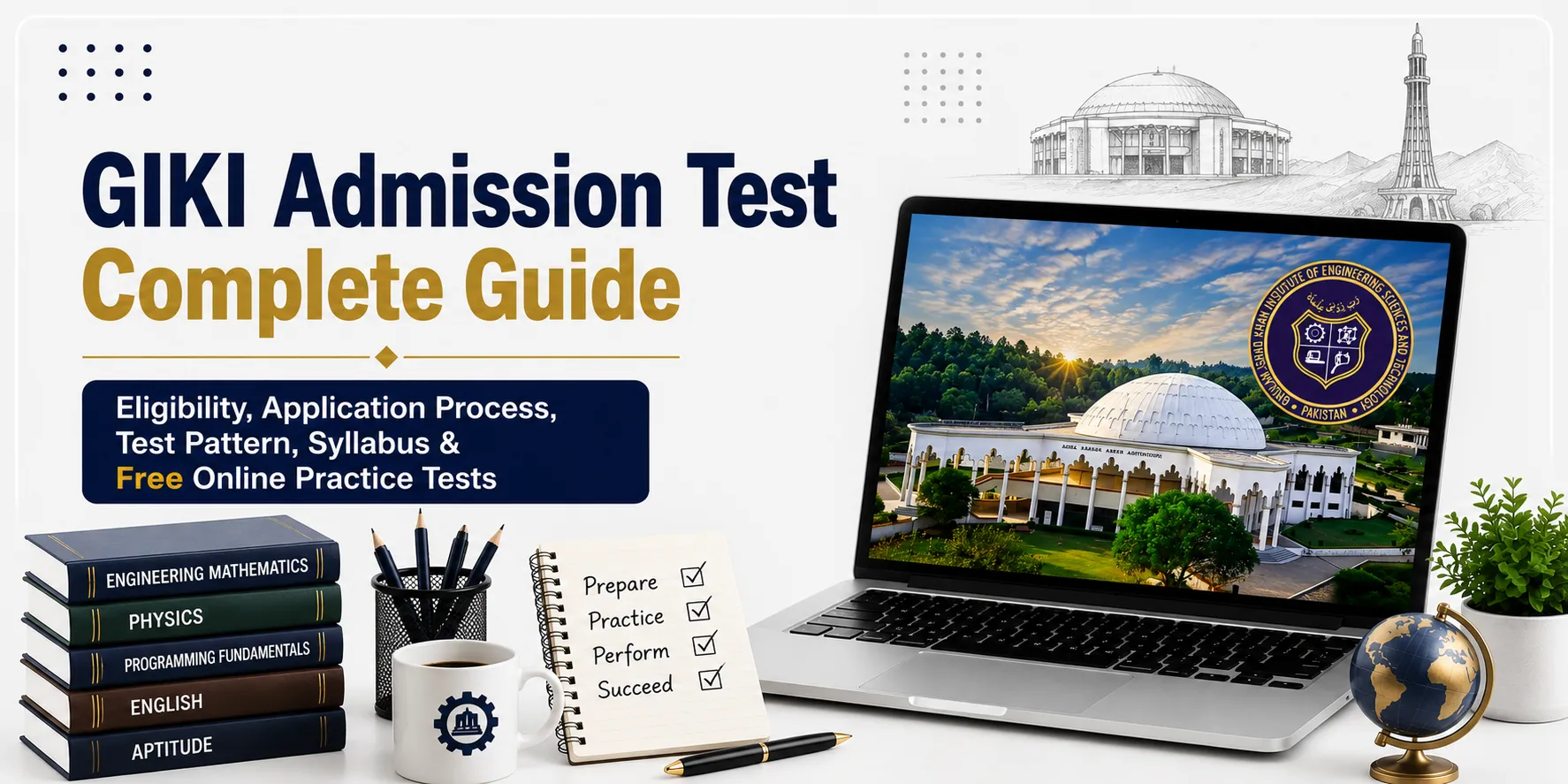
GIKI Admission Test Complete Guide
Eligibility, Application Process, Test Pattern, Syllabus & Free Online Practice Tests
The Ghulam Ishaq Khan Institute of Engineering Sciences and Technology (GIKI) is one of Pakistan's most prestigious engineering and technology universities. Established in 1993, GIKI has earned a reputation for academic excellence, world-class faculty, state-of-the-art facilities, and a fully residential campus experience. Located in Topi, District Swabi, Khyber Pakhtunkhwa, GIKI attracts thousands of applicants every year who aspire to pursue careers in engineering, computer science, and emerging technologies.
If you are planning to apply for GIKI admissions, this comprehensive guide covers everything you need to know:
-
What is the GIKI admission test?
-
What are the eligibility criteria?
-
What undergraduate programs are offered?
-
How to apply online?
-
What is the test pattern and marking scheme?
-
What is the complete syllabus?
-
How can I practice GIKI MCQs online for free?
Students who want to begin their preparation immediately can start with GIKI Free Quiz , where hundreds of free chapter-wise quizzes are available to strengthen concepts and improve exam performance.
About GIKI
The Ghulam Ishaq Khan Institute of Engineering Sciences and Technology is a federally chartered private research university named after the former President of Pakistan. GIKI offers undergraduate and graduate programs in engineering, computer science, and management sciences. The institute is known for its rigorous academic standards, modern campus, and strong industry connections.
The GIKI admission test serves as the primary gateway for undergraduate admissions. The test is conducted simultaneously at multiple test centers across Pakistan, including Rawalpindi, Peshawar, Lahore, Quetta, Karachi, and Multan.
Why Choose GIKI?
-
Academic excellence with top rankings among Pakistani engineering universities
-
Fully residential campus with a vibrant learning community
-
Modern laboratories, libraries, and research centers
-
Strong industry linkages for internships and placements
-
Generous need-based and merit-based scholarships
-
Diverse range of engineering, computing, and management programs
GIKI Undergraduate Programs
GIKI offers a variety of undergraduate Bachelor degree programs:
Engineering Programs
-
Chemical Engineering
-
Civil Engineering
-
Computer Engineering
-
Electrical Engineering
-
Mechanical Engineering
Computing Programs
-
Artificial Intelligence (AI)
-
Computer Engineering (CE)
-
Computer Science (CS)
-
Cyber Security (CyS)
-
Data Science (DS)
-
Software Engineering (SE)
Management Sciences
-
BS Management Sciences
Candidates with Mathematics, Physics, and Chemistry backgrounds can apply for all programs including Computer Science and Computer Engineering. Candidates with a Computer Science/Computer Studies background instead of Chemistry can only apply for Computer Engineering or Computer Science.
GIKI Eligibility Criteria
For FSc (HSSC) Candidates
-
HSSC (Pre-Engineering): Must have studied Mathematics, Physics, and Chemistry with 60% or above marks in each subject and overall.
-
HSSC (Pre-Medical): Must have Additional Mathematics with 60% or above marks in each of Mathematics, Physics, and overall.
-
ICS: Eligible for CS, AI, and Cyber Security programs.
For A-Level Candidates
-
Must have studied Mathematics, Physics, and Chemistry with grade D or above in each.
-
O-Level in eight subjects (English, Mathematics, Physics, Chemistry, Biology/Computer Science, Urdu, Islamic Studies & Pakistan Studies) for local applicants.
-
For applicants from abroad: O-Level in five subjects (English, Mathematics, Physics, Chemistry, Biology/Computer Science).
-
IBCC equivalence is mandatory.
For American or Canadian High School Diploma or International Baccalaureate (IB) Diploma
-
Must have Mathematics (with Calculus), Physics, and Chemistry with 60% or above marks as per IBCC equivalence formula.
For B.Sc. Candidates
-
B.Sc. with Mathematics and Physics with 60% or above marks each in Mathematics, Physics, and overall.
For DAE Candidates
-
Three-year Diploma of Associate Engineering (DAE) in relevant technology with at least 60% marks each in Mathematics, Physics, and overall.
For Candidates with Foreign Qualifications
-
IBCC equivalence is required.
-
Result-awaiting students can apply provisionally.
GIKI Application Process
The application process is conducted entirely online through the official GIKI admissions portal.
Step-by-Step Application Guide
-
Visit the Official Admissions Portal: admissions.giki.edu.pk
-
Create an Account: Register with your email address and create a password.
-
Fill in the Online Application Form: Enter your personal details, academic information, and program preferences.
-
Upload Documents: Upload recent color photograph and required academic documents.
-
Pay the Application Fee: Print the Bank Challan, make payment at the designated bank, and fill in the paid bank challan details in your profile.
-
Submit Application: Review all information and submit your application before the deadline.
-
Download Admit Card: After successful submission and payment, download your admit card from the portal.
-
Choose Test Center and Date: Select your preferred test center and test date within the test window.
Tentative Admission Timeline
-
Registration typically opens in March/April.
-
Registration usually closes in May/June.
-
GIKI Admission Test is generally held in July.
-
Merit lists and results are typically announced in July/August.
Always verify exact dates on the official GIKI website: www.giki.edu.pk .
GIKI Test Pattern
The GIKI admission test is a computer-based test consisting of 80 multiple-choice questions (MCQs) . The test is designed to assess knowledge in three core subjects: Mathematics, Physics, and English. There is no negative marking in any section.
Test Pattern Overview
-
Total MCQs: 80
-
Total Marks: 200
-
Time Allowed: 120 minutes (2 hours)
-
Test Mode: Computer-Based
-
Negative Marking: None
Section-Wise Breakdown
-
Mathematics: 30 MCQs (90 marks) — 3 marks each
-
Physics: 30 MCQs (90 marks) — 3 marks each
-
English: 20 MCQs (20 marks) — 1 mark each
The test is held simultaneously at Rawalpindi, Peshawar, Lahore, Quetta, Karachi, and Multan. Applicants can choose the test center according to their convenience. No retakes are allowed in the same cycle.
GIKI Syllabus
The GIKI admission test syllabus is based on the intermediate and A-Level curriculum. Below is the chapter-wise breakdown for each subject.
Start your preparation with GIKI Practice Test .
Mathematics (30 MCQs)
The Mathematics section covers a wide range of topics from intermediate level. Start your preparation with GIKI Maths Practice Tests .
The Mathematics syllabus includes:
-
Number Systems — Real Numbers, Complex Numbers, Sets, Linear Equations, Matrices, Determinants, Simultaneous Equations, Polynomials
-
Set Theory — Sets, Functions
-
Functions — Functions
-
Quadratic Equations — Solution of Equations, Relationship between Roots and Coefficients
-
Sequence and Series — Arithmetic Progression (AP), Geometric Progression (GP), Harmonic Progression (HP), Basic Statistics, Probability, Permutations, Combinations
-
Mathematical Induction — Mathematical Induction, Binomial Theorem, Binomial Series
-
Trigonometry — Trigonometric Equations, Functions, Inverse Functions, Angles, Applications
-
Differential Calculus — Functions, Limits, Differentiation
-
Integral Calculus — Integration, Areas, Volumes
-
Analytic Geometry — Analytic Geometry, Conic Sections
-
Vectors — Vectors in Plane and Space, Scalar Product, Vector Product, Triple Product of Vectors
-
Miscellaneous — Assorted topics in Mathematics
Physics (30 MCQs)
The Physics section assesses understanding of core physical concepts. Start your preparation with GIKI Physics Practice Tests .
The Physics syllabus includes:
-
Measurements and Vectors — SI Units, Errors, Physical Quantities, Vectors, Equilibrium
-
Motion and Work — Force, Linear Motion, Circular Motion, Work, Power, Energy, Fluid Dynamics
-
Waves and Oscillation — Propagation of Waves, Superposition of Waves, Stationary Waves, Doppler's Effect, Simple Harmonic Motion (SHM), Free and Forced Oscillation
-
Optics — Principles, Instruments
-
Heat and Thermodynamics — Kinetic Theory of Gases, Laws of Thermodynamics, Entropy
-
Electricity — Electrostatics, Current, DC, AC, Potential, Laws, Electromagnetism, Electromagnetic Induction, Electronics, Devices
-
Modern Physics — Relativity, Quantum Theory, Atomic Physics, Nuclear Physics
-
Miscellaneous — Assorted topics in Physics
English (20 MCQs)
The English section tests grammar, vocabulary, and comprehension skills. Start your preparation with GIKI English Practice Tests .
The English syllabus includes:
-
Reading Comprehension — Content and Context Understanding, Idiomatic and Colloquial Use of Language, Inference and Deductive Reasoning
-
Vocabulary — Synonyms, Antonyms
-
Correct Usage — Tense Agreement, Usage, Language Patterns
-
Miscellaneous — Assorted topics in English
GIKI Merit Calculation
GIKI merit is determined primarily by performance in the admission test, along with academic records. The admission test carries the highest weightage.
The merit formula for GIKI admissions is as follows:
-
Admission Test Score: 85% weightage
-
HSSC Part I + SSC/Equivalent: 10% + 5% weightage
-
O-Level (for A-Level candidates): 15% weightage
GIKI does not publicly release program-wise closing merit, but historically, top programs require strong test performance.
GIKI Fee Structure (Tentative)
The fee structure for GIKI undergraduate programs is as follows:
Engineering & Computing Programs
-
Semester Fee: PKR 470,000
-
Annual Fee: PKR 940,000
Management Sciences
-
Semester Fee: PKR 412,500
-
Annual Fee: PKR 825,000
Other Charges
-
Admission Fee: PKR 75,000 (one-time)
-
Security Deposit: PKR 40,000 (refundable)
Fee structure is subject to change. Verify from the official GIKI website.
GIKI Preparation Tips
1. Understand the Test Pattern
The GIKI test has 80 MCQs with no negative marking. Focus on accuracy rather than speed. Since there is no penalty for wrong answers, you can attempt all questions confidently.
2. Know the Syllabus Thoroughly
Familiarize yourself with the complete chapter-wise syllabus for Mathematics, Physics, and English. Use the official syllabus as a checklist to ensure you cover every topic.
3. Practice Chapter by Chapter
Complete one chapter at a time and immediately attempt the relevant chapter-wise quiz. The free quizzes on Pak Admissions are designed specifically for this purpose.
4. Focus on High-Yield Topics
-
Mathematics: Calculus, Trigonometry, Algebra, and Vectors are heavily tested.
-
Physics: Mechanics, Electricity, Thermodynamics, and Modern Physics form the core.
-
English: Reading Comprehension, Vocabulary, and Correct Usage are key areas.
5. Take Full-Length Mock Tests
Take full-length mock tests under timed conditions to improve your time management skills and build the stamina needed for the actual 120-minute exam.
6. Analyze Your Mistakes
Review every mistake. Understanding why you got a question wrong is how you truly learn and avoid repeating the same errors.
7. Start Early
Begin your preparation well in advance. Don't wait until the last month. Starting early gives you the best results.
Final Words
Securing admission to GIKI is a significant achievement that opens the door to a promising career in engineering and technology. With its rigorous academic standards, modern campus, and strong industry connections, GIKI offers an unparalleled educational experience. Start your preparation today by exploring the chapter-wise practice quizzes available on Pak Admissions .
Good luck with your GIKI Admission Test preparation!