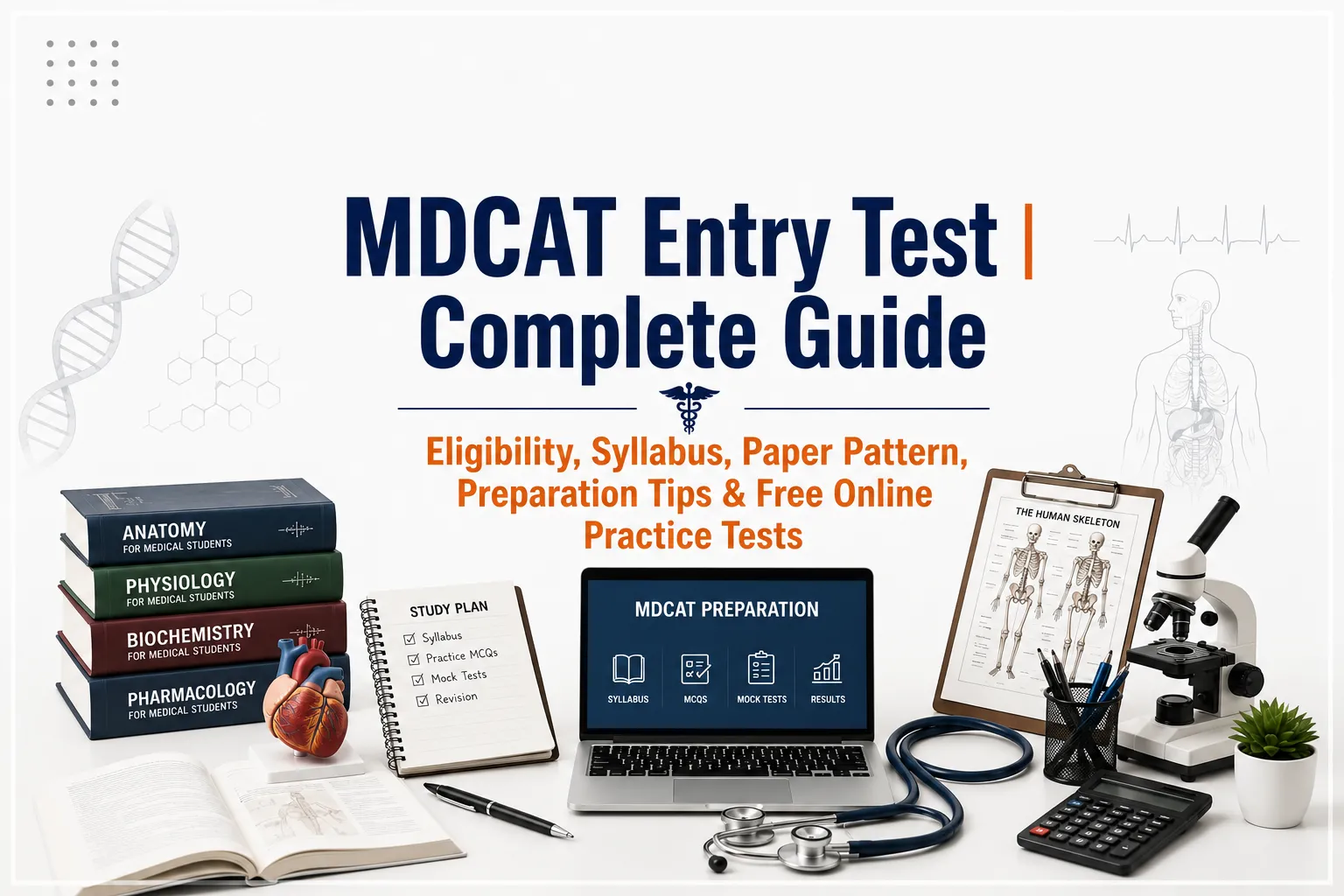
MDCAT 2026 – A Complete Guide (A-Z)
Introduction
The Medical and Dental College Admission Test (MDCAT) is the most important entrance examination for students who want to study MBBS or BDS in Pakistan. Every year, thousands of students appear in the MDCAT with the dream of getting admission to a government or private medical and dental college. A good MDCAT score can significantly improve your chances of securing admission to your preferred medical college.
Preparing for the MDCAT is not only about studying textbooks. Students must also understand the eligibility criteria, registration process, syllabus, test pattern, merit calculation, preparation strategy, and admission procedure. Many students lose marks or face admission problems simply because they are unaware of important rules and deadlines.
This complete MDCAT 2026 guide covers every major aspect of the examination in simple and easy English. Whether you are appearing for the first time, improving your previous score, or planning your preparation well in advance, this guide will help you understand the entire process from registration to final admission.
What is MDCAT?
The Medical and Dental College Admission Test (MDCAT) is a standardized entrance test for admission to undergraduate medical and dental programs in Pakistan. It evaluates whether students have the knowledge and skills required to begin medical education.
The MDCAT is mandatory for admission to:
-
MBBS
-
BDS
The examination mainly tests students in:
-
Biology
-
Chemistry
-
Physics
-
English
-
Logical Reasoning
The test is based mainly on the FSc (Pre-Medical) curriculum and equivalent qualifications.
Why is MDCAT Important?
The MDCAT plays a major role in medical admissions across Pakistan.
Its importance includes:
-
It is required for admission to MBBS and BDS programs.
-
It helps universities assess students fairly.
-
It contributes significantly to the overall merit.
-
It provides equal opportunities to students from different educational boards.
-
It measures conceptual understanding instead of memorization alone.
A high MDCAT score increases your chances of admission to highly competitive medical colleges.
Who Should Apply for MDCAT 2026?
MDCAT is suitable for:
-
Students who have completed FSc (Pre-Medical).
-
Students waiting for their FSc Part-II results, if allowed under the applicable rules.
-
Students with A-Level or equivalent qualifications.
-
Students who wish to improve their previous MDCAT score.
-
Overseas Pakistani students seeking admission in Pakistan.
-
Students applying to private medical colleges.
-
Students applying to government medical colleges.
Benefits of Taking MDCAT
Appearing in MDCAT offers several advantages.
Some major benefits include:
-
Eligibility for MBBS admissions.
-
Eligibility for BDS admissions.
-
Opportunity to apply to government medical colleges.
-
Opportunity to apply to private medical colleges.
-
Opportunity to apply to NUMS administered medical colleges.
-
Recognition by medical admission authorities.
-
A standardized evaluation system for all candidates.
MDCAT 2026 Overview
Although the exact schedule may change, students should expect the following stages during MDCAT 2026.
The process generally includes:
-
Announcement of admission schedule.
-
Fee submission.
-
Admit card issuance.
-
MDCAT examination.
-
Result announcement.
-
Medical college admissions.
Students should regularly check official announcements and avoid waiting until the last date.
Who Conducts MDCAT?
The overall policies for MDCAT are set by the relevant medical regulatory authority, while the examination may be conducted through designated public universities in different provinces or regions.
Depending on your province, you may appear in the test conducted by the designated admitting university.
Students should always register through the official registration portal announced for their respective region.
Eligibility Criteria for MDCAT 2026
Before applying, every student should carefully read the eligibility criteria.
Generally, applicants should meet the following requirements.
Academic Qualification
Applicants should have:
-
FSc (Pre-Medical) or equivalent qualification.
-
Biology as a compulsory subject.
-
Chemistry as a compulsory subject.
-
Physics as a compulsory subject.
Equivalent qualifications are usually accepted after completing the required equivalence process.
A-Level Students
Students with A-Level qualifications should:
-
Obtain equivalence from the relevant authority.
-
Complete all required documentation before admission.
-
Meet the minimum eligibility requirements announced for admissions.
Repeaters
Students who appeared in previous MDCAT examinations can usually apply again.
Many students improve their score after taking another attempt.
Overseas Students
Pakistani nationals living abroad may also apply if they fulfill the required eligibility conditions.
Additional documentation may be required depending on the admission policy.
Documents Required for MDCAT Registration
Students should prepare their documents before registration begins.
Commonly required documents include:
-
Valid CNIC or B-Form.
-
Recent passport-size photograph.
-
Email address.
-
Mobile number.
-
Educational certificates or result cards.
-
Equivalence certificate (if applicable).
-
Registration fee payment proof.
Keeping digital copies ready can save time during online registration.
How to Register for MDCAT 2026
The registration process is generally completed online.
The basic steps include:
-
Visit the official registration portal.
-
Create your account.
-
Enter personal information.
-
Enter educational details.
-
Select your preferred examination center, if available.
-
Pay the registration fee.
-
Submit the application.
-
Download or print the confirmation page.
Always review your application carefully before final submission.
Common Registration Mistakes
Many students make simple mistakes that can create problems later.
Avoid the following:
-
Using an incorrect CNIC or B-Form number.
-
Entering the wrong name.
-
Using an inactive mobile number.
-
Uploading unclear photographs.
-
Waiting until the last date.
-
Forgetting to submit the application after fee payment.
-
Ignoring official instructions.
Double-check every detail before submitting your application.
Registration Tips
To make the registration process easier:
-
Register as early as possible.
-
Use a reliable internet connection.
-
Keep all documents ready.
-
Save your application number.
-
Download all confirmation documents.
-
Keep screenshots of important steps.
MDCAT Examination Centers
MDCAT is usually conducted in multiple cities to facilitate students from different regions.
Students should:
-
Select the nearest available examination center whenever possible.
-
Visit the center before the examination day if they are unfamiliar with the location.
-
Reach the center well before the reporting time.
Late arrival may result in unnecessary stress or even disqualification under certain rules.
MDCAT Test Pattern
Understanding the test pattern is one of the most important parts of preparation.
Students should know:
-
Total number of questions.
-
Total examination time.
-
Distribution of questions among subjects.
-
Type of questions.
-
Passing criteria.
-
Marking scheme.
A clear understanding of the paper pattern helps students prepare more effectively.
Subjects Included in MDCAT
The MDCAT generally consists of questions from:
-
Biology
-
Chemistry
-
Physics
-
English
-
Logical Reasoning
Each subject contributes to the overall score, so students should not ignore any section.
Nature of Questions
Most MDCAT questions are:
-
Multiple Choice Questions (MCQs).
-
Concept-based.
-
Analytical.
-
Application-oriented.
-
Based on understanding rather than memorization.
Students who understand concepts usually perform better than those who rely only on rote learning.
Difficulty Level
The MDCAT is considered a competitive examination because thousands of students compete for a limited number of seats.
The paper may include:
-
Easy questions.
-
Moderate questions.
-
Challenging conceptual questions.
Students should prepare for all difficulty levels instead of focusing only on easy topics.
How is MDCAT Different from Board Exams?
Many students think that scoring high marks in FSc automatically guarantees a high MDCAT score. However, both examinations are different.
Board examinations usually focus on:
-
Textbook knowledge.
-
Written answers.
-
Long questions.
-
Short questions.
MDCAT mainly focuses on:
-
Conceptual understanding.
-
Quick thinking.
-
Analytical ability.
-
Time management.
-
Accurate MCQ solving.
Therefore, students should prepare specifically for the MDCAT instead of relying only on board examination preparation.
What Makes Students Successful in MDCAT?
Students who perform well usually have the following habits:
-
They study consistently.
-
They revise regularly.
-
They practice MCQs every day.
-
They solve past papers.
-
They attempt mock tests.
-
They improve weak subjects.
-
They manage time effectively.
-
They remain motivated throughout their preparation.
Success in MDCAT is the result of continuous effort rather than last-minute preparation.
Key Points to Remember
Before starting your preparation, remember these important points:
-
Understand the syllabus before studying.
-
Follow a realistic study plan.
-
Focus on concepts instead of memorization.
-
Practice MCQs daily.
-
Revise regularly.
-
Solve full-length mock tests.
-
Stay updated with official announcements.
-
Keep all registration documents ready.
-
Avoid unnecessary stress.
-
Believe in consistent hard work.
The right preparation strategy, combined with discipline and regular practice, can greatly improve your chances of achieving an excellent MDCAT score.
MDCAT 2026 – A Complete Guide (A-Z)
MDCAT Syllabus 2026
The MDCAT syllabus is the foundation of your preparation. Before opening any book or solving MCQs, you should know exactly what topics are included in the test. Many students waste time studying topics that are not part of the syllabus, while others ignore important chapters that carry more conceptual questions.
Always prepare according to the latest official syllabus announced for MDCAT 2026. If any changes are made, update your preparation plan accordingly.
The MDCAT syllabus is divided into five major subjects:
-
Biology
-
Chemistry
-
Physics
-
English
-
Logical Reasoning
Each subject requires a different preparation strategy.
Biology Preparation
Biology usually contributes the largest portion of the MDCAT paper. Since it carries the highest weightage, students should spend more time mastering Biology concepts.
How to Study Biology
-
Read every chapter carefully.
-
Understand concepts instead of memorizing lines.
-
Learn scientific terms correctly.
-
Revise diagrams even if they are not directly asked.
-
Practice chapter-wise MCQs daily.
-
Revise difficult topics multiple times.
Important Biology Topics
Students should pay special attention to topics related to:
-
Cell Biology
-
Biological Molecules
-
Enzymes
-
Bioenergetics
-
Cell Cycle
-
Diversity Among Organisms
-
Human Physiology
-
Reproduction
-
Genetics
-
Evolution
-
Biotechnology
Do not skip any chapter because MDCAT questions may come from any part of the syllabus.
Biology Preparation Tips
-
Prepare one chapter completely before moving to the next.
-
Make short notes for revision.
-
Learn scientific names carefully.
-
Memorize important biological processes.
-
Solve previous MCQs after every chapter.
-
Revise weak chapters every week.
Chemistry Preparation
Chemistry requires both conceptual understanding and memorization. Students should understand reactions, formulas, and concepts rather than learning them blindly.
Major Areas of Chemistry
Chemistry preparation usually includes:
-
Physical Chemistry
-
Organic Chemistry
-
Inorganic Chemistry
Each area is equally important.
Important Chemistry Topics
Students should prepare topics such as:
-
Atomic Structure
-
Chemical Bonding
-
States of Matter
-
Thermochemistry
-
Chemical Equilibrium
-
Reaction Kinetics
-
Electrochemistry
-
Organic Compounds
-
Hydrocarbons
-
Alcohols
-
Aldehydes
-
Ketones
-
Carboxylic Acids
-
Biomolecules
Chemistry Preparation Tips
-
Learn chemical reactions step by step.
-
Understand concepts before memorizing equations.
-
Revise formulas regularly.
-
Solve numerical problems.
-
Practice conceptual MCQs.
-
Review difficult reactions every week.
Physics Preparation
Physics is often considered one of the most challenging sections because many questions test conceptual understanding.
Students should not memorize formulas only. They should understand when and how to apply them.
Important Physics Topics
Focus on:
-
Measurements
-
Motion
-
Force
-
Work and Energy
-
Circular Motion
-
Fluid Dynamics
-
Oscillations
-
Waves
-
Heat
-
Thermodynamics
-
Electrostatics
-
Current Electricity
-
Electromagnetism
-
Electronics
-
Atomic Physics
-
Nuclear Physics
Physics Preparation Tips
-
Understand every formula.
-
Practice numerical questions regularly.
-
Draw simple diagrams where helpful.
-
Learn units carefully.
-
Solve conceptual MCQs daily.
-
Practice calculations without using shortcuts.
English Preparation
Many students ignore English because they think it is easy. However, English can significantly affect your overall score.
English Topics
Prepare topics including:
-
Vocabulary
-
Synonyms
-
Antonyms
-
Sentence Completion
-
Grammar
-
Prepositions
-
Tenses
-
Active and Passive Voice
-
Direct and Indirect Speech
-
Error Detection
-
Reading Comprehension
English Preparation Tips
-
Read English daily.
-
Learn new vocabulary.
-
Practice grammar exercises.
-
Solve English MCQs regularly.
-
Improve reading speed.
-
Revise common grammar rules.
Logical Reasoning Preparation
Logical Reasoning tests your ability to think critically.
This section usually does not require memorization.
Instead, it tests:
-
Analytical thinking
-
Problem solving
-
Pattern recognition
-
Logical decision making
Preparation Tips
-
Practice reasoning questions daily.
-
Read each question carefully.
-
Avoid guessing too quickly.
-
Improve concentration.
-
Learn common reasoning patterns.
Best Books for MDCAT Preparation
Choosing the right books is very important. Studying from too many books often creates confusion.
A good study plan usually includes:
-
Your FSc textbooks
-
MDCAT preparation books
-
Chapter-wise MCQ books
-
Past paper books
-
Mock test books
While selecting books:
-
Prefer updated editions.
-
Choose books with detailed explanations.
-
Practice MCQs after every chapter.
-
Avoid collecting too many resources.
Quality is always better than quantity.
Online Study Resources
Today, students can prepare effectively using online resources.
Useful resources include:
-
Online notes
-
Video lectures
-
Practice MCQs
-
Mock tests
-
Chapter-wise quizzes
-
Past papers
-
Preparation blogs
-
Revision notes
Use online resources to strengthen your understanding, not to replace regular textbook study.
How to Make a Study Plan
A proper study plan helps students complete the syllabus on time.
Before making your plan:
-
Know how much time you have.
-
Divide the syllabus into small parts.
-
Set weekly goals.
-
Include revision.
-
Include MCQ practice.
-
Include mock tests.
Avoid making unrealistic schedules that cannot be followed.
Sample Daily Study Routine
A balanced study routine may include:
-
Review yesterday's work.
-
Study one new concept.
-
Solve chapter-wise MCQs.
-
Revise previous chapters.
-
Practice one weak topic.
-
Read English vocabulary.
-
Solve a few logical reasoning questions.
Daily consistency is more important than studying for very long hours occasionally.
Weekly Preparation Strategy
Every week, students should:
-
Complete planned chapters.
-
Revise previous topics.
-
Attempt one full practice test.
-
Analyze mistakes.
-
Improve weak concepts.
-
Update short notes.
Never finish a week without revision.
Importance of Short Notes
Short notes help during the final revision.
Your notes may include:
-
Important formulas.
-
Biological terms.
-
Chemical reactions.
-
Physics equations.
-
Grammar rules.
-
Difficult concepts.
-
Frequently forgotten points.
Keep your notes simple and easy to revise.
Importance of Revision
Many students study new topics every day but forget old chapters.
Revision helps:
-
Improve memory.
-
Increase confidence.
-
Reduce mistakes.
-
Strengthen concepts.
-
Prepare for mock tests.
Good students revise regularly instead of waiting until the last month.
Chapter-wise MCQ Practice
MCQ practice is essential for MDCAT success.
After completing each chapter:
-
Solve chapter-wise MCQs.
-
Check incorrect answers.
-
Understand why the answer was wrong.
-
Revise the related concept.
-
Solve another set of MCQs.
Learning from mistakes is one of the fastest ways to improve.
Full-Length Mock Tests
Mock tests help students experience the real examination environment.
Benefits include:
-
Better time management.
-
Improved speed.
-
Increased confidence.
-
Identification of weak areas.
-
Better concentration.
-
Reduced examination anxiety.
Treat every mock test like the actual MDCAT.
How to Analyze Your Mock Test
Taking a test is only half the work.
After every test:
-
Count your correct answers.
-
Identify weak subjects.
-
Review incorrect questions.
-
Understand every mistake.
-
Revise related concepts.
-
Repeat difficult questions later.
Students improve more by analyzing tests than by taking many tests without review.
Common Preparation Mistakes
Avoid these common mistakes:
-
Studying without a schedule.
-
Ignoring one subject.
-
Memorizing without understanding.
-
Not practicing MCQs.
-
Skipping revision.
-
Collecting too many books.
-
Ignoring weak chapters.
-
Comparing yourself with others.
-
Depending only on coaching academies.
-
Studying only during the last few weeks.
Avoiding these mistakes can greatly improve your performance.
Signs That Your Preparation is Going Well
You are on the right track if:
-
You understand concepts easily.
-
Your mock test scores are improving.
-
You finish questions more quickly.
-
You remember previous chapters.
-
You make fewer mistakes.
-
You feel more confident.
-
Your revision takes less time.
Progress may be slow in the beginning, but consistency always brings results.
Final Advice Before Moving to Advanced Preparation
Remember these important points:
-
Complete the syllabus first.
-
Build strong concepts.
-
Practice MCQs every day.
-
Revise regularly.
-
Analyze your mistakes honestly.
-
Stay disciplined.
-
Remain patient.
-
Believe in continuous improvement.
A well-planned preparation strategy is much more effective than studying randomly for long hours.
MDCAT 2026 – A Complete Guide (A-Z)
Practice MCQs and Past Papers
Completing the syllabus is only the first step. To achieve a high MDCAT score, you must practice as many MCQs as possible. Regular MCQ practice helps you improve speed, accuracy, and confidence.
Many students spend months reading textbooks but very little time solving MCQs. As a result, they know the concepts but struggle to answer questions quickly during the exam.
A balanced preparation plan should include:
-
Studying concepts.
-
Solving chapter-wise MCQs.
-
Attempting topic-wise tests.
-
Solving past papers.
-
Taking full-length mock tests.
Why are Past Papers Important?
Past papers help you understand the style of the MDCAT examination.
They allow you to:
-
Understand the pattern of questions.
-
Identify important topics.
-
Improve your confidence.
-
Learn time management.
-
Discover your weak areas.
-
Practice real examination-level questions.
Past papers should not be used to predict exact questions. Instead, they should be used to understand the level and style of the examination.
How to Use Past Papers Effectively
Do not start solving past papers on your first day of preparation.
A better approach is:
-
Complete the relevant chapter first.
-
Practice chapter-wise MCQs.
-
Revise your notes.
-
Solve questions from previous MDCAT papers.
-
Review every incorrect answer.
-
Repeat difficult questions after a few days.
This method improves long-term learning.
Importance of Mock Tests
Mock tests simulate the real examination.
They help students:
-
Improve concentration.
-
Increase speed.
-
Build confidence.
-
Reduce examination stress.
-
Learn how to manage time.
-
Practice answering questions under pressure.
Attempt mock tests regularly throughout your preparation.
How Often Should You Take Mock Tests?
The number of mock tests depends on your preparation stage.
A general strategy is:
-
During early preparation:
-
Focus mainly on chapter-wise tests.
-
-
After completing half the syllabus:
-
Start taking partial mock tests.
-
-
After completing the syllabus:
-
Attempt full-length mock tests regularly.
-
-
During the final weeks:
-
Increase the frequency of full mock tests and revision.
-
How to Improve Your Mock Test Score
After every mock test:
-
Check your total score.
-
Review incorrect answers.
-
Find out why each mistake happened.
-
Revise the related chapter.
-
Practice similar MCQs.
-
Keep a notebook of repeated mistakes.
Never ignore your mistakes because they often appear again in future tests.
Time Management During MDCAT
Time management is just as important as knowledge.
Many students know the correct answers but fail to complete the paper because they spend too much time on difficult questions.
A good strategy is:
-
Read each question carefully.
-
Answer easy questions first.
-
Avoid spending too much time on one question.
-
Return to difficult questions later if time permits.
-
Keep an eye on the remaining time throughout the examination.
Speed should never come at the cost of accuracy.
Tips for Solving MCQs
While solving MCQs:
-
Read the complete question.
-
Read all answer choices.
-
Eliminate obviously incorrect options.
-
Focus on keywords.
-
Avoid making assumptions.
-
Do not change correct answers without a valid reason.
-
Stay calm even if you encounter difficult questions.
Careless mistakes often reduce the overall score.
Revision Strategy
Revision is one of the most important parts of MDCAT preparation.
Without revision, students forget previously studied topics.
An effective revision plan includes:
-
Daily revision.
-
Weekly revision.
-
Monthly revision.
-
Final revision before the examination.
During revision:
-
Read short notes.
-
Revise formulas.
-
Review difficult concepts.
-
Solve important MCQs.
-
Focus on weak chapters.
Revision should become a regular habit rather than a last-minute activity.
Last Month Before MDCAT
The final month should be used wisely.
Focus on:
-
Completing any remaining topics.
-
Revising the complete syllabus.
-
Solving full-length mock tests.
-
Practicing past papers.
-
Improving weak subjects.
-
Maintaining good health.
Avoid starting completely new books during the last month.
Last Week Before MDCAT
During the final week:
-
Revise your short notes.
-
Solve selected MCQs.
-
Review important formulas.
-
Practice previously incorrect questions.
-
Sleep properly.
-
Stay positive.
Avoid unnecessary stress and panic.
One Day Before MDCAT
One day before the examination:
-
Do not study for very long hours.
-
Revise only important points.
-
Prepare your documents.
-
Check the examination center location.
-
Arrange transportation.
-
Sleep early.
-
Stay relaxed.
A fresh mind performs better than a tired one.
Exam Day Guidelines
On the examination day:
-
Wake up early.
-
Eat a healthy breakfast.
-
Carry all required documents.
-
Reach the examination center well before reporting time.
-
Follow all official instructions.
-
Stay calm while waiting for the paper.
Avoid discussing difficult topics with other students before entering the examination hall.
During the Examination
While attempting the paper:
-
Read instructions carefully.
-
Fill required information correctly.
-
Manage your time wisely.
-
Stay focused.
-
Do not panic if you find difficult questions.
-
Continue solving confidently.
Remember that every student receives the same paper.
Common Exam-Day Mistakes
Students should avoid:
-
Arriving late.
-
Forgetting important documents.
-
Panicking after seeing difficult questions.
-
Spending too much time on one MCQ.
-
Ignoring simple questions.
-
Making random guesses without reading carefully.
-
Losing confidence after one difficult section.
Keeping a calm mind can improve your performance significantly.
What Happens After MDCAT?
After the examination:
-
The answer sheets are evaluated.
-
Results are announced.
-
Merit is calculated.
-
Admissions begin according to the announced schedule.
Students should keep checking official announcements during this period.
Understanding Merit
Admission to medical colleges is based on merit.
Merit usually depends on:
-
Academic performance.
-
MDCAT score.
-
Admission policy applicable for the current session.
Higher marks generally improve your chances of admission.
Choosing Medical Colleges
Before applying for admission:
-
Learn about different medical colleges.
-
Compare their programs.
-
Understand their admission requirements.
-
Check previous merit trends.
-
Consider the location.
-
Review available facilities.
Apply carefully according to your merit and preferences.
Government Medical Colleges
Government medical colleges are highly competitive because:
-
Tuition fees are generally lower.
-
They have a strong academic reputation.
-
They receive a large number of applications.
Students usually require higher merit to secure admission.
Private Medical Colleges
Private medical colleges also offer MBBS and BDS programs.
Before applying:
-
Check recognition status.
-
Understand the fee structure.
-
Review admission criteria.
-
Compare available facilities.
-
Read admission instructions carefully.
Apply only after understanding all requirements.
Maintaining Motivation
Preparing for MDCAT can be stressful.
Stay motivated by:
-
Setting realistic goals.
-
Following your study plan.
-
Celebrating small achievements.
-
Learning from mistakes.
-
Taking short breaks.
-
Maintaining a healthy lifestyle.
-
Staying away from unnecessary distractions.
Remember that consistent effort produces better results than occasional hard work.
Frequently Asked Questions
Can I prepare for MDCAT without joining an academy?
Yes. Many students successfully prepare through self-study by following the syllabus, practicing MCQs, solving past papers, and taking mock tests regularly.
How many hours should I study daily?
Quality matters more than the number of hours. Study consistently every day and focus on understanding concepts rather than simply spending long hours with books.
Are FSc textbooks enough?
FSc textbooks should be your primary source for conceptual learning. However, you should also practice chapter-wise MCQs, past papers, and mock tests.
Should I memorize everything?
No.
You should:
-
Understand concepts.
-
Learn important definitions.
-
Memorize essential formulas and scientific terms.
-
Practice applying concepts through MCQs.
Is Biology the only important subject?
No.
Although Biology usually carries significant weight, every subject contributes to your final score. Ignoring Physics, Chemistry, English, or Logical Reasoning can lower your overall merit.
When should I start preparing?
The earlier you start, the better your preparation will be. Consistent study over several months is generally more effective than last-minute preparation.
Final Tips for MDCAT Success
If you want to achieve an excellent MDCAT score:
-
Understand the syllabus completely.
-
Follow a realistic study schedule.
-
Build strong concepts.
-
Study from reliable resources.
-
Practice MCQs every day.
-
Revise regularly.
-
Solve past papers.
-
Attempt mock tests.
-
Improve weak subjects.
-
Stay physically healthy.
-
Sleep properly.
-
Believe in yourself.
-
Remain disciplined until the examination.
Every mark matters in a competitive examination. Small improvements made every day can make a significant difference in your final result.
Conclusion
The MDCAT is one of the most competitive examinations in Pakistan, but success is achievable with proper planning, consistent effort, and smart preparation. Instead of relying only on memorization, focus on understanding concepts, practicing MCQs, revising regularly, and learning from your mistakes.
Remember that thousands of successful doctors once stood where you are today. They achieved their goals through patience, discipline, and continuous hard work. Stay committed to your preparation, follow the official guidelines, and make the best use of your study time.
We hope this complete MDCAT 2026 guide has helped you understand every major aspect of the examination—from eligibility and registration to preparation, mock tests, merit, and admission. Use this guide as your roadmap throughout your MDCAT journey, and continue exploring detailed resources such as chapter-wise notes, practice MCQs, past papers, mock tests, merit calculators, admission updates, and medical college information to strengthen your preparation.
We wish you the very best for MDCAT 2026 and your future medical career.