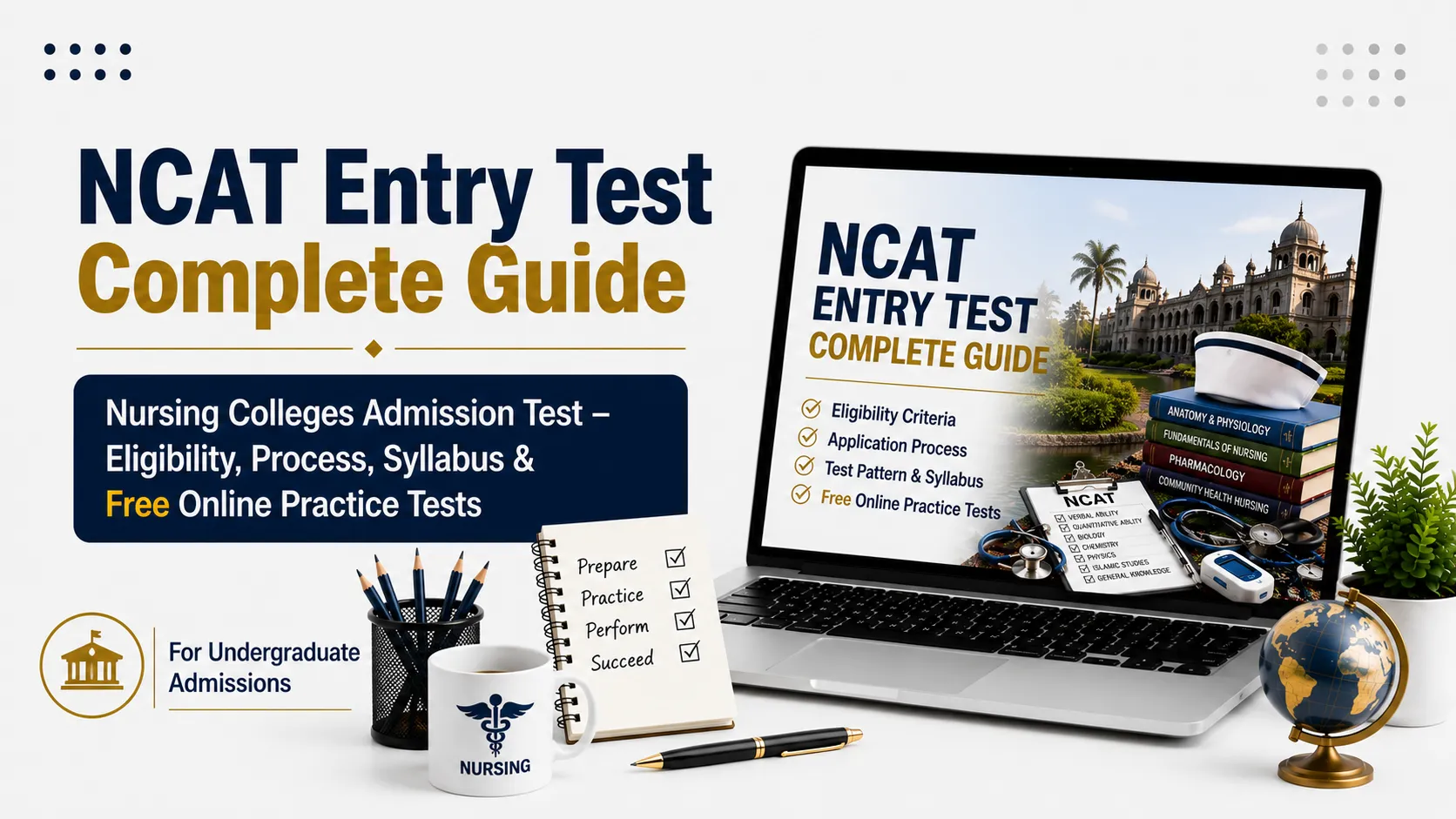
Nursing Colleges Admission Test – Eligibility, Process, Syllabus & Free Online Practice Tests
The Nursing Colleges Admission Test (NCAT) is a standardized entrance examination conducted for admission to 4-year Generic BS Nursing programs in various public and private sector nursing colleges across Pakistan. NCAT serves as a crucial gateway for students aspiring to enter the noble and dignified profession of nursing.
If you are planning to apply for BS Nursing admissions through NCAT, this comprehensive guide covers everything you need to know:
-
What is the NCAT and which nursing colleges accept it?
-
What is the complete admission process?
-
What are the eligibility criteria?
-
How to apply for NCAT?
-
What is the test pattern, number of MCQs, and time allowed?
-
What is the complete syllabus?
-
How can I practice NCAT MCQs online for free?
Students who want to begin their preparation immediately can start with NCAT Practice Test , where hundreds of free chapter-wise quizzes are available to strengthen concepts and improve exam performance.
What is NCAT?
NCAT is a multiple-choice, paper-based exam conducted in the English language. The test is designed to assess a candidate's knowledge and understanding of core subjects at the intermediate level, including English, Physics, Chemistry, and Biology.
NCAT is primarily conducted by:
-
Bolan University of Medical & Health Sciences (BUMHS), Quetta for nursing colleges in Balochistan
-
Directorate of Nursing Sindh for public sector nursing colleges in Sindh
-
Various other provincial nursing admission authorities
Nursing Colleges Accepting NCAT
NCAT is accepted by numerous public and private sector nursing colleges across Pakistan. Below is a list of institutions that use NCAT or similar nursing admission tests for their BS Nursing programs.
Balochistan – BUMHS Quetta
Bolan University of Medical & Health Sciences (BUMHS) conducts NCAT for admission to nursing colleges across Balochistan. These include:
-
Government Nursing Colleges in various districts of Balochistan
-
Affiliated nursing institutions under BUMHS
Sindh – Directorate of Nursing Sindh
The Directorate of Nursing Sindh conducts NCAT for admission to public sector nursing colleges in Sindh. These include:
-
College of Nursing (Male) Jacobabad
-
College of Nursing (Male) Larkana
-
College of Nursing (Male) Sir CJ Institute of Psychiatry Hyderabad
-
College of Nursing, Sindh Government Hospital Korangi No. 5 Karachi
-
Various other government nursing colleges across Sindh
Other Important Nursing Colleges
-
CON Shoukat Khanum Hospital
-
CON Shalamar Hospital
-
CON Ittefaq Hospital
-
CON Saeeda Waheed
-
CON University of Lahore
-
Asian Institute of Nursing & Health Sciences
-
National University of Medical Sciences (NUMS), Islamabad
-
Various private nursing colleges that accept NCAT or equivalent tests
In total, over 18 nursing colleges across Pakistan accept NCAT for BS Nursing admissions.
Note: Candidates are advised to check the official admission advertisement of their desired nursing college for confirmation of NCAT acceptance.
NCAT Eligibility Criteria
Eligibility criteria for NCAT may vary slightly depending on the conducting authority. Below are the general requirements:
Educational Requirements
-
Intermediate / F.Sc Pre-Medical with at least 50% marks
-
Physics, Chemistry, and Biology are compulsory subjects
-
Matric Science with at least 55% marks with Physics, Chemistry, and Biology as compulsory subjects
Age Requirements
-
18 to 30 years (age counted up to the last date for application submission)
Domicile Requirements
-
Candidate must have Domicile and PRC from the respective province
-
For Sindh: Domicile and PRC from any district of Sindh Province
Boards Accepted
-
Sindh education boards and Federal Board are accepted for candidates having Sindh domicile
-
Other provincial boards as per the conducting authority's policy
Other Requirements
-
FRC from NADRA (Family Registration Certificate)
-
Family tree and father domicile registered in the respective province
NCAT Application Process
The application process for NCAT varies slightly depending on the nursing college and the conducting authority. Below is a general guide that applies to most institutions.
General Application Steps
-
Visit the Official Admission Portal:
-
Check the official website of the nursing college you wish to apply to.
-
For Sindh-based public sector colleges, the test is typically conducted through Sindh Testing Service (STS) at www.sts.org.pk .
-
For Balochistan-based colleges, the test is conducted through Bolan University of Medical & Health Sciences (BUMHS) at www.bumhs.edu.pk .
-
Private nursing colleges may have their own application portals.
-
-
Register and Fill Application Form:
-
Create an account on the relevant admission portal.
-
Fill in your personal and academic details accurately.
-
Select the desired nursing program and college.
-
-
Upload Required Documents:
-
Matric certificate with mark sheet
-
Intermediate (F.Sc Pre-Medical) certificate with mark sheet
-
Candidate CNIC (front and back)
-
Domicile and PRC certificate
-
Father/Guardian FRC from NADRA (if applicable)
-
Recent passport-size photograph
-
-
Pay the Application Fee:
-
Download the system-generated challan.
-
Deposit the fee at any online branch of the designated bank.
-
Application fee varies by institution and conducting authority.
-
-
Submit Application:
-
Review all information before final submission.
-
Submit the online application form.
-
For some institutions, send the duly filled application form, original paid bank deposit slip, and attested required documents by post or courier.
-
-
Download Admit Card:
-
After successful submission and payment, download your admit card from the portal.
-
Print the admit card and bring it to the test center.
-
Admission Timeline
-
Registration typically opens in June/July
-
Registration usually closes in June/July
-
Eligible/Ineligible Candidates List is published after the closing date
-
NCAT Test Date is announced in the admit card or on the official portal
Always verify exact dates and procedures on the official admission portal of your desired nursing college. Admission timelines and processes are subject to change each year.
Key Points to Remember
-
Domicile Requirement: Candidates must have domicile from the respective province.
-
Boards Accepted: Sindh education boards, Federal Board, and other provincial boards as per the conducting authority's policy.
-
Result-Awaiting Candidates: Some colleges may allow provisional application for result-awaiting students. Check the official policy.
NCAT Test Pattern
NCAT is a multiple-choice, paper-based exam conducted in the English language.
Test Pattern Overview
-
Total MCQs: 100
-
Test Mode: Paper-Based
-
Language: English
-
Subjects: Intermediate level English, Physics, Chemistry, and Biology
Section-Wise Breakdown
-
English: 20% – 25% weightage
-
Physics: 20% – 25% weightage
-
Chemistry: 20% – 25% weightage
-
Biology: 20% – 25% weightage
Exact distribution may vary by conducting authority.
NCAT Merit Calculation Formula
The final merit for NCAT admissions is calculated using the following formula:
-
Intermediate Marks: 30% weightage
-
Aptitude Test (NCAT): 70% weightage
Admissions are granted strictly on merit according to test results and the admission policy of the respective nursing directorate.
NCAT Syllabus
The NCAT syllabus is based on the intermediate (F.Sc Pre-Medical) curriculum. Below is the chapter-wise breakdown for each subject.
Start your preparation with NCAT Practice Test .
Biology
The Biology section covers a wide range of topics from intermediate level. Start your preparation with NCAT Biology Practice Tests .
The Biology syllabus includes:
-
Acellular Life — Viruses, Prions, Viroids
-
Bioenergetics — Photosynthesis, Respiration, Energy Metabolism
-
Biological Molecules — Carbohydrates, Proteins, Lipids, Nucleic Acids
-
Biotechnology — Genetic Engineering, Cloning, DNA Technology
-
Cell Structure and Function — Cell Organelles, Cell Membrane, Cell Division
-
Circulation — Heart, Blood Vessels, Blood Circulation
-
Coordination and Control — Nervous System, Hormones, Reflexes
-
Digestion — Digestive System, Enzymes, Nutrient Absorption
-
Enzymes — Enzyme Structure, Function, Kinetics
-
Evolution — Theories of Evolution, Natural Selection
-
Homeostasis — Osmoregulation, Thermoregulation, Excretion
-
Immunity — Immune System, Antibodies, Vaccines
-
Inheritance — Mendelian Genetics, DNA, Chromosomes
-
Reproduction — Asexual and Sexual Reproduction, Human Reproduction
-
Respiration — Respiratory System, Gas Exchange
-
Support and Movement — Skeletal System, Muscles, Locomotion
Chemistry
The Chemistry section covers physical, inorganic, and organic chemistry. Start your preparation with NCAT Chemistry Practice Tests .
The Chemistry syllabus includes:
-
Alcohols and Phenols — Alcohols, Phenols, Ethers
-
Aldehydes and Ketones — Aldehydes, Ketones, Reactions
-
Alkyl Halides — Haloalkanes, Reactions
-
Atomic Structure — Atomic Models, Quantum Numbers, Electronic Configuration
-
Carboxylic Acids — Carboxylic Acids, Derivatives
-
Chemical Bonding — Ionic, Covalent, Metallic Bonds
-
Chemical Equilibrium — Equilibrium Constant, Le Chatelier's Principle
-
Chemistry of Hydrocarbons — Alkanes, Alkenes, Alkynes
-
Electrochemistry — Electrochemical Cells, Electrolysis
-
Fundamental Principles of Organic Chemistry — Organic Chemistry Basics, Functional Groups
-
Gases — Gas Laws, Kinetic Molecular Theory
-
Industrial Chemistry — Industrial Processes, Fertilizers, Polymers
-
Intro of Fundamental Concept of Chemistry — Stoichiometry, Mole Concept
-
Liquids — Properties of Liquids, Vapor Pressure
-
Macro Molecules — Polymers, Biomolecules
-
Reaction Kinetics — Rate of Reaction, Factors Affecting Rate
-
Reading and Thinking — Analytical Chemistry, Data Interpretation
-
S and P Block Elements — Groups IA-VIIIA Elements
-
Solids — Crystalline and Amorphous Solids
-
Thermo Chemistry — Enthalpy, Entropy, Gibbs Free Energy
-
Transition Elements — d-Block Elements, Coordination Compounds
Physics
The Physics section assesses understanding of core physical concepts. Start your preparation with NCAT Physics Practice Tests .
The Physics syllabus includes:
-
Alternating Current — AC Circuits, Resonance
-
Atomic Spectra — Atomic Spectra, Bohr's Model
-
Current Electricity — Ohm's Law, Circuits, Resistivity
-
Dawn of Modern Physics — Relativity, Quantum Theory
-
Electromagnetic Induction — Faraday's Law, Lenz's Law
-
Electromagnetism — Magnetic Fields, Forces
-
Electronics — Semiconductors, Diodes, Transistors
-
Electrostatics — Coulomb's Law, Electric Fields
-
Fluid Dynamics — Bernoulli's Equation, Viscosity
-
Forces and Motion — Newton's Laws, Kinematics
-
Nuclear Physics — Radioactivity, Nuclear Reactions
-
Rotational and Circular Motion — Torque, Angular Momentum
-
Thermodynamics — Laws of Thermodynamics, Heat Engines
-
Vector and Equilibrium — Vectors, Equilibrium Conditions
-
Waves — Wave Properties, Sound Waves
-
Work and Energy — Work, Power, Energy Conservation
Logical Reasoning
The Logical Reasoning section tests analytical and critical thinking skills. Start your preparation with NCAT Logical Reasoning Practice Tests .
The Logical Reasoning syllabus includes:
-
Cause and Effect — Identifying cause and effect relationships
-
Course of Action — Determining appropriate actions
-
Critical Thinking — Analytical reasoning and problem solving
-
Letter and Symbols Series — Pattern recognition in letters and symbols
-
Logical Deductions — Drawing conclusions from premises
-
Logical Problems — Solving complex logical puzzles
NCAT Preparation Tips
1. Understand the Test Pattern
NCAT consists of 100 MCQs from Intermediate level English, Physics, Chemistry, and Biology. Focus on all four subjects equally.
2. Know the Syllabus Thoroughly
Familiarize yourself with the complete chapter-wise syllabus. Use the chapter lists above as a checklist to ensure you cover every topic.
3. Practice Chapter by Chapter
Complete one chapter at a time and immediately attempt the relevant chapter-wise quiz. The free quizzes on Pak Admissions are designed specifically for this purpose.
4. Focus on High-Yield Topics
-
Biology: Cell Structure, Bioenergetics, Inheritance, and Human Physiology are heavily tested.
-
Chemistry: Organic Chemistry, Chemical Bonding, and Electrochemistry form the core.
-
Physics: Mechanics, Electricity, and Thermodynamics are key areas.
-
Logical Reasoning: Practice all question types regularly.
5. Take Full-Length Mock Tests
Take full-length mock tests under timed conditions to improve your time management skills and build stamina.
6. Analyze Your Mistakes
Review every mistake. Understanding why you got a question wrong is how you truly learn and avoid repeating the same errors.
7. Start Early
Begin your preparation well in advance. Don't wait until the last month. Starting early gives you the best results.
Final Words
NCAT is your gateway to a rewarding career in nursing at top institutions including Shoukat Khanum Hospital, Shalamar Hospital, Ittefaq Hospital, Saeeda Waheed, University of Lahore, and many other prestigious nursing colleges across Pakistan. With the right preparation strategy and consistent practice, you can achieve a high score and secure admission to your desired nursing college. Start your preparation today by exploring the chapter-wise practice quizzes available on Pak Admissions .
Good luck with your NCAT preparation!