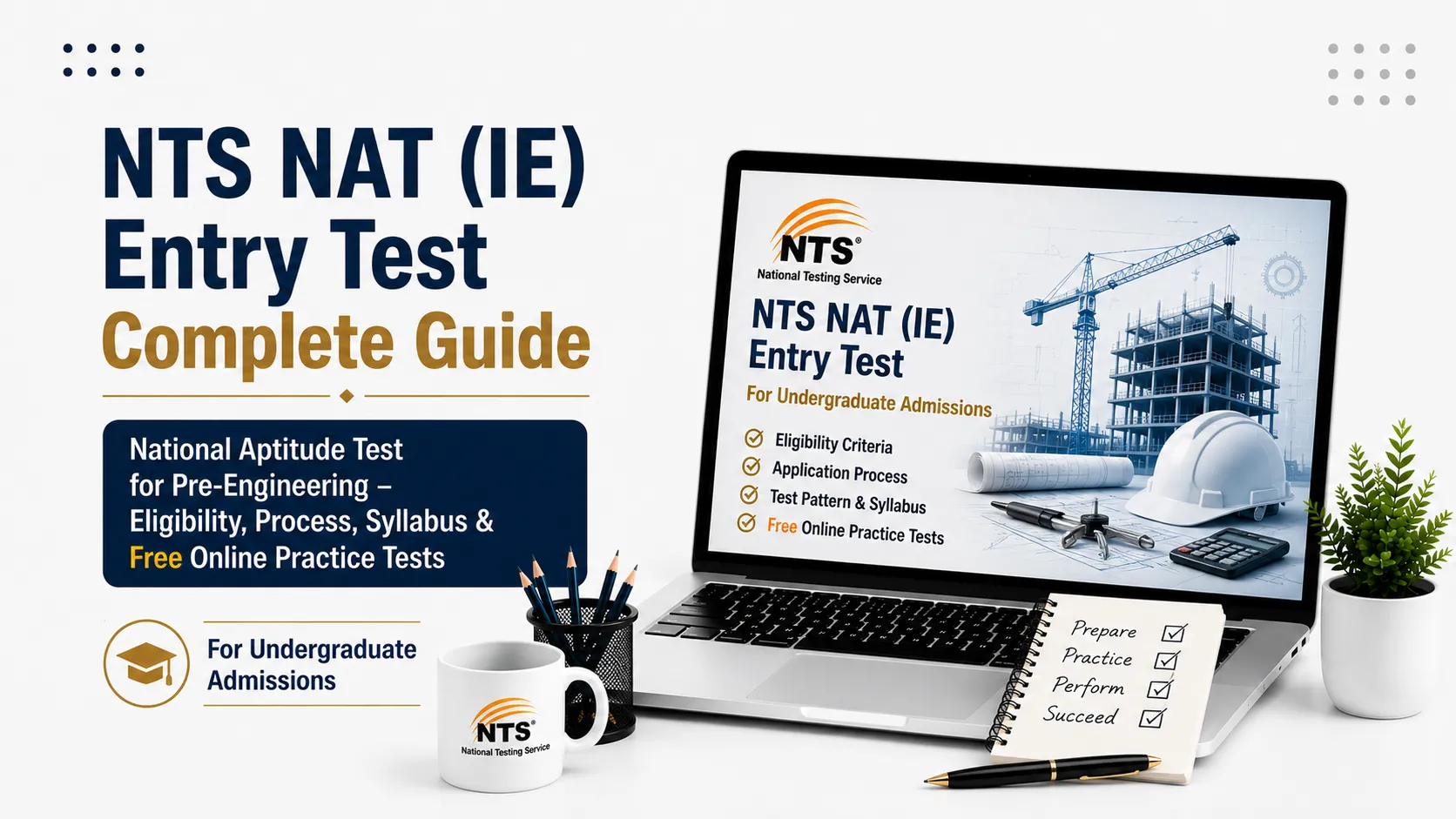
National Aptitude Test for Pre-Engineering – Eligibility, Process, Syllabus & Free Online Practice Tests
The National Aptitude Test (NAT) is a standardized entrance examination conducted by the National Testing Service (NTS) of Pakistan. It serves as a gateway for students seeking admission to undergraduate (4-year Bachelor's) programs at universities and degree-awarding institutes (DAIs) recognized by the Higher Education Commission (HEC).
The NAT IE is a specific category of NAT-I designed for candidates who have completed their intermediate education in the Pre-Engineering group and wish to pursue undergraduate degrees in fields like Engineering, Technology, and other science disciplines.
If you are planning to apply for undergraduate admissions through NTS NAT IE, this comprehensive guide covers everything you need to know:
-
What is the NTS NAT IE test and which programs accept it?
-
Which universities accept NAT IE?
-
What are the eligibility criteria?
-
How to apply for NTS NAT?
-
What is the test pattern, number of MCQs, and time allowed?
-
What is the complete syllabus?
-
How can I practice NTS NAT IE MCQs online for free?
Students who want to begin their preparation immediately can start with NTS Free Quiz , where hundreds of free chapter-wise quizzes are available to strengthen concepts and improve exam performance.
What is NTS NAT IE?
NAT IE is one of the six categories of NAT-I tests offered by NTS. The six NAT-I categories are:
-
NAT-IA: Arts & Humanities Group
-
NAT-IE: Pre-Engineering Group
-
NAT-IM: Pre-Medical Group
-
NAT-ICS: Computer Science Group
-
NAT-ICOM: Commerce Group
-
NAT-IGS: General Science Group
NAT IE is specifically designed for candidates from the Pre-Engineering background. The test includes subject-related questions from Physics, Chemistry, and Mathematics along with aptitude-based sections.
The test is valid for one year from the date of result declaration. Candidates can appear for the test multiple times and use their best score for admissions.
Which Programs Accept NAT IE?
NAT IE is accepted for admission to a wide range of Bachelor's (4-year) programs in Engineering, Technology, and related fields. Common programs include:
-
BE / BS in Electrical Engineering
-
BE / BS in Mechanical Engineering
-
BE / BS in Civil Engineering
-
BE / BS in Chemical Engineering
-
BE / BS in Computer Engineering
-
BE / BS in Aerospace Engineering
-
BS in Engineering Sciences
-
BS in Computer Science (for some universities)
-
BSc in Technology programs
-
And other engineering and technology-related programs
NAT IE is not for Pre-Medical, Commerce, Computer Science (unless specified), or Arts programs. Candidates for those fields must appear for NAT-IM, NAT-ICOM, NAT-ICS, or NAT-IA respectively.
Universities Accepting NAT IE
NAT is accepted by numerous universities and degree-awarding institutes (DAIs) across Pakistan that are associated with NTS. Some of the well-known institutions that accept NAT IE for undergraduate admissions include:
-
COMSATS University, Islamabad – All Campuses
-
FAST - National University of Computer & Emerging Sciences (NUCES) – All Campuses
-
Air University, Islamabad
-
Bahria University, Islamabad
-
Institute of Space Technology (IST), Islamabad
-
Quaid-i-Azam University (QAU), Islamabad
-
National University of Sciences and Technology (NUST) – selected programs
-
University of Engineering & Technology (UET), Peshawar
-
University of Engineering & Technology (Institute of Business & Management), Lahore
-
Gomal University, D.I. Khan
-
Government College University (GCU), Faisalabad
-
Kinnaird College for Women, Lahore
-
National Textile University, Faisalabad
-
University of Gujrat
-
University of Peshawar
-
University of Balochistan, Quetta
-
Balochistan University of Information Technology & Management Sciences (BUITMS), Quetta
-
Capital University of Science & Technology, Islamabad
-
GIFT University, Gujranwala
-
HITEC University, Taxila
-
Institute of Management Sciences, Peshawar
-
Institute of Southern Punjab, Multan
-
NAMAL University, Mianwali
-
National Defense University (NDU), Islamabad
-
Riphah International University, Islamabad
-
Sarhad University of Science & Information Technology, Peshawar
-
The Superior College, Lahore
-
University of Management & Technology (UMT), Lahore
-
University of South Asia
-
University of Science & Technology, Bannu
-
CECOS University, Peshawar
-
Federal Urdu University of Arts, Science & Technology
-
International Islamic University, Islamabad
-
Kohat University of Science and Technology, Kohat
-
Shaheed Zulfiqar Ali Bhutto Medical University, Islamabad
-
University of Azad Jammu & Kashmir
-
And many other public and private sector universities
Note: This is not an exhaustive list. Candidates are advised to check the official admission advertisement of their desired university to confirm whether NAT IE is accepted for their chosen program.
NTS NAT IE Eligibility Criteria
The eligibility criteria for NAT IE are clearly defined by NTS:
Educational Requirements
-
12 years of education (Intermediate / HSSC) in the Pre-Engineering group
-
Candidates with A-Level or equivalent qualifications must have IBCC equivalence certificate
-
The test is not for candidates from Pre-Medical, Commerce, Computer Science, or Arts backgrounds
Age Requirements
-
No specific age limit is prescribed by NTS
-
Candidates must meet the age requirements of the university they are applying to
Domicile Requirements
-
Candidates from all provinces of Pakistan can apply
-
Some universities may have specific domicile requirements – check the university's admission policy
Test Validity
-
The NAT score is valid for one year from the date of result declaration
Other Requirements
-
Candidates must have a valid CNIC/B-Form and a recent passport-size photograph
-
Candidates must register online through the NTS Candidate Portal at portal.nts.org.pk
NTS NAT IE Application Process
The application process for NTS NAT is conducted online through the NTS Candidate Portal.
Step-by-Step Application Guide
-
Visit the Official NTS Website: www.nts.org.pk
-
Create an Account: Click on the NTS Candidate Portal. Register with your email address and create a password. Complete your personal profile.
-
Select the Test: Choose NAT-IE (Pre-Engineering) from the list of available tests. The test fee is typically around PKR 1,510/-.
-
Fill in the Application Form: Enter your personal details, academic information, and CNIC/B-Form number. Upload a recent passport-size photograph with a clear front face.
-
Pay the Application Fee: Download the system-generated challan or deposit slip. Deposit the fee at any online branch of the designated bank. Keep the original NTS copy of the deposit slip.
-
Submit Application: Review all information before final submission. Submit the online application form. For some tests, send the duly filled application form and original deposit slip by post or courier.
-
Download Roll Number Slip: After successful submission and payment, download your roll number slip from the portal. Print the slip and bring it to the test center.
Test Schedule
-
NTS NAT tests are conducted once or twice monthly
-
The test is held at multiple centers across Pakistan
-
Candidates can choose their preferred test date and center
Always verify exact dates and procedures on the official NTS website www.nts.org.pk .
NTS NAT IE Test Pattern
NAT IE is a paper-based exam consisting of 90 multiple-choice questions (MCQs) to be completed in 120 minutes (2 hours).
Test Pattern Overview
-
Total MCQs: 90
-
Total Time: 120 minutes (2 hours)
-
Test Mode: Paper-Based
-
Negative Marking: None
-
Total Marks: 90 (1 mark per MCQ)
-
Test Validity: 1 year
Section-Wise Breakdown
-
English: 20 MCQs
-
Analytical Reasoning: 20 MCQs
-
Quantitative Reasoning: 20 MCQs
-
Subject Section (Physics, Chemistry, Mathematics): 30 MCQs
Subject Section Breakdown
-
Physics: 10 MCQs
-
Chemistry: 10 MCQs
-
Mathematics: 10 MCQs
Detailed Section-wise Distribution
English (20 MCQs)
-
Sentence Completion: 5 MCQs
-
Analogy: 3 MCQs
-
Antonym: 4 MCQs
-
Comprehension: 5 MCQs
-
Synonym: 3 MCQs
Analytical Reasoning (20 MCQs)
-
Scenario Based: 12 MCQs
-
Statements Based: 8 MCQs
Quantitative Reasoning (20 MCQs)
-
Arithmetic: 13 MCQs
-
Algebra: 4 MCQs
-
Geometry: 3 MCQs
Subject Section (30 MCQs)
-
Physics: 10 MCQs
-
Chemistry: 10 MCQs
-
Mathematics: 10 MCQs
NTS NAT IE Syllabus
The NTS NAT IE syllabus is based on the intermediate (HSSC) Pre-Engineering curriculum. Below is the chapter-wise breakdown for each section.
Start your preparation with NTS NAT IE Practice Test .
English (20 MCQs)
The English section evaluates reading comprehension, vocabulary, grammar, and sentence structure. Start your preparation with NTS NAT IE English Practice Tests .
The English syllabus includes:
-
Antonyms – Words with opposite meanings
-
Comprehension – Reading comprehension passages
-
Parts of Speech – Nouns, verbs, adjectives, adverbs, etc.
-
Subject Verb Agreement – Grammar rules for subject-verb agreement
-
Synonyms – Words with similar meanings
-
Tenses – Present, past, and future tenses
-
Word Usage – Correct usage of words in sentences
-
Sentence Completion – Fill in the blanks, vocabulary in context
-
Analogy – Verbal analogies
Logical and Analytical Thinking (20 MCQs)
The Analytical Reasoning section tests logical thinking, relationships, and pattern recognition. Start your preparation with NTS NAT IE Logical and Analytical Thinking Practice Tests .
The Analytical Reasoning syllabus includes:
-
Blood Relations – Family tree and relationship problems
-
Cause and Effect – Identifying cause and effect relationships
-
Coding and Decoding – Coding and decoding problems
-
Course of Action – Determining appropriate actions
-
Decision Making – Decision-making scenarios
-
Direction and Distance – Direction and distance problems
-
Logical Deduction – Drawing conclusions from premises
-
Non-Verbal Reasoning – Pattern recognition and visual reasoning
-
Ranking and Sequencing – Ranking and sequencing problems
-
Seating Arrangement – Arrangement problems
-
Series and Patterns – Number and letter series
-
Statements and Arguments – Evaluating arguments
-
Statements and Assumptions – Identifying assumptions
-
Statements and Conclusions – Drawing conclusions
-
Syllogism – Logical syllogisms
Quantitative Reasoning (20 MCQs)
The Quantitative Reasoning section covers basic mathematical concepts. Start your preparation with NTS NAT IE Quantitative Reasoning Practice Tests .
The Quantitative Reasoning syllabus includes:
-
Arithmetic – Percentages, ratios, averages, profit and loss (13 MCQs)
-
Algebra – Basic algebraic concepts, linear equations (4 MCQs)
-
Geometry and Mensuration – Basic geometry and measurements (3 MCQs)
Physics (10 MCQs)
Physics questions are based on the intermediate Pre-Engineering curriculum. Start your preparation with NTS NAT IE Physics Practice Tests .
The Physics syllabus includes:
-
Measurements – SI Units, errors, physical quantities
-
Motion and Force – Newton's laws, kinematics, dynamics
-
Work and Energy – Work, power, energy conservation
-
Rotational and Circular Motion – Torque, angular momentum
-
Vectors and Equilibrium – Vectors, equilibrium conditions
-
Waves – Wave properties, sound waves
-
Oscillations – Simple harmonic motion
-
Geometrical Optics – Reflection, refraction, lenses
-
Physical Optics – Interference, diffraction, polarization
-
Current Electricity – Ohm's law, circuits, resistivity
-
Electrostatics – Coulomb's law, electric fields
-
Electromagnetism – Magnetic fields, forces on moving charges
-
Electromagnetic Induction – Faraday's law, Lenz's law
-
Electronics – Semiconductors, diodes, transistors
-
Alternating Current – AC circuits, resonance
-
Atomic Spectra – Atomic spectra, Bohr's model
-
Dawn of Modern Physics – Relativity, quantum theory
-
Nuclear Physics – Radioactivity, nuclear reactions
-
Fluid Dynamics – Bernoulli's equation, viscosity
Chemistry (10 MCQs)
Chemistry questions are based on the intermediate Pre-Engineering curriculum. Start your preparation with NTS NAT IE Chemistry Practice Tests .
The Chemistry syllabus includes:
-
Basic Concepts – Stoichiometry, mole concept
-
Chemical Bonding – Ionic, covalent, metallic bonds
-
Gases – Gas laws, kinetic molecular theory
-
Liquids – Properties of liquids, vapor pressure
-
Solids – Crystalline and amorphous solids
-
Chemical Equilibrium – Equilibrium constant, Le Chatelier's principle
-
Reaction Kinetics – Rate of reaction, factors affecting rate
-
Electrochemistry – Electrochemical cells, electrolysis
-
Thermochemistry – Enthalpy, entropy, Gibbs free energy
-
Fundamental Principles of Organic Chemistry – Organic chemistry basics, functional groups
-
Aliphatic Hydrocarbons – Alkanes, alkenes, alkynes
-
Aromatic Hydrocarbons – Benzene and derivatives
-
Alkyl Halides – Haloalkanes, reactions
-
Alcohols and Phenols – Alcohols, phenols, ethers
-
Aldehydes and Ketones – Aldehydes, ketones, reactions
-
Carboxylic Acids – Carboxylic acids, derivatives
-
S Block Elements – Groups IA-IIA elements
-
Macromolecules – Polymers, biomolecules
-
Common Chemical Industries in Pakistan – Industrial processes, fertilizers, polymers
-
Experimental Techniques – Laboratory techniques, analysis
Mathematics (10 MCQs)
Mathematics questions are based on the intermediate Pre-Engineering curriculum. Start your preparation with NTS NAT IE Maths Practice Tests .
The Mathematics syllabus includes:
-
Number Systems – Real numbers, complex numbers
-
Sets Functions and Groups – Sets, functions, groups
-
Matrices and Determinants – Matrices, determinants, inverse
-
Quadratic Equations – Solution of quadratic equations
-
Partial Fractions – Partial fractions decomposition
-
Sequences and Series – AP, GP, HP
-
Mathematical Induction and Binomial Theorem – Induction principle, binomial expansion
-
Permutation Combination and Probability – Counting principles, probability
-
Trigonometry – Trigonometric functions and identities
-
Functions and Limits – Domain and range, limits
-
Differentiation – Basic calculus, derivatives
-
Integration – Integrals, areas
-
Coordinate Geometry – Straight lines, circles
-
Analytical Geometry in Three Dimensions – 3D geometry
-
Differential Equations – Basic differential equations
-
Vectors – Vectors in 2D and 3D
NTS NAT IE Merit Calculation
The final merit for NTS NAT-based admissions is determined by universities based on their specific admission policies. Generally, the merit formula includes:
-
NTS NAT Test Score: Significant weightage
-
Intermediate (HSSC) Marks: Weightage as per university policy
-
Matric (SSC) Marks: Weightage as per university policy
Merit Benchmarks:
-
For engineering programs, a high score in mathematics and physics significantly boosts chances of admission
-
Strong scores can significantly improve merit rankings and increase the likelihood of securing seats in highly competitive engineering programs
-
Different universities have different merit criteria. Some universities may give higher weightage to the NTS NAT score, while others may prioritize academic marks
NTS NAT IE Preparation Tips
-
Understand the Test Pattern: NAT IE consists of 90 MCQs from English, Analytical Reasoning, Quantitative Reasoning, Physics, Chemistry, and Mathematics. Focus on all sections equally.
-
Know the Syllabus Thoroughly: Familiarize yourself with the complete chapter-wise syllabus. Use the chapter lists above as a checklist to ensure you cover every topic.
-
Practice Chapter by Chapter: Complete one chapter at a time and immediately attempt the relevant chapter-wise quiz. The free quizzes on Pak Admissions are designed specifically for this purpose.
-
Focus on High-Yield Topics:
-
Mathematics: Calculus, trigonometry, algebra, and vectors are heavily tested
-
Physics: Mechanics, electricity, magnetism, and thermodynamics form the core
-
Chemistry: Chemical bonding, organic chemistry, and electrochemistry are key areas
-
English: Vocabulary, grammar, comprehension
-
Analytical Reasoning: Practice all question types regularly
-
Quantitative Reasoning: Arithmetic, algebra, geometry
-
-
Strengthen Core Concepts: Since NAT-IE focuses on mathematics, physics, and chemistry, ensure that your core concepts from high school are clear. This includes topics like calculus, thermodynamics, electromagnetism, and chemical bonding.
-
Practice NTS NAT Past Papers: Going through NTS NAT past papers will give you an idea of the type of questions that are asked and the format of the exam. Solve official NAT past papers under exam conditions to understand question patterns and timings.
-
Daily MCQ Practice: Attempt timed 20–30 MCQs daily (mix of verbal, analytical & quantitative).
-
Take Full-Length Mock Tests: Take full-length mock tests under timed conditions (2 hours) to improve your time management skills and build stamina.
-
Analyze Your Mistakes: Review every mistake. Understanding why you got a question wrong is how you truly learn and avoid repeating the same errors.
-
Time Management: The exam consists of 90 MCQs in 120 minutes. Practice time management to ensure you can attempt all questions.
-
Appear Multiple Times: As NTS is conducted frequently, it is advisable to appear in NTS at least 2-3 times to improve your marks.
-
Use Official NTS Resources: Visit the official NTS website www.nts.org.pk for the latest updates, test schedules, and sample papers.
Final Words
NTS NAT IE is your gateway to a wide range of undergraduate programs in Engineering and Technology at top universities across Pakistan. With the right preparation strategy and consistent practice, you can achieve a high score and secure admission to your desired program. Start your preparation today by exploring the chapter-wise practice quizzes available on Pak Admissions .
Good luck with your NTS NAT IE preparation!