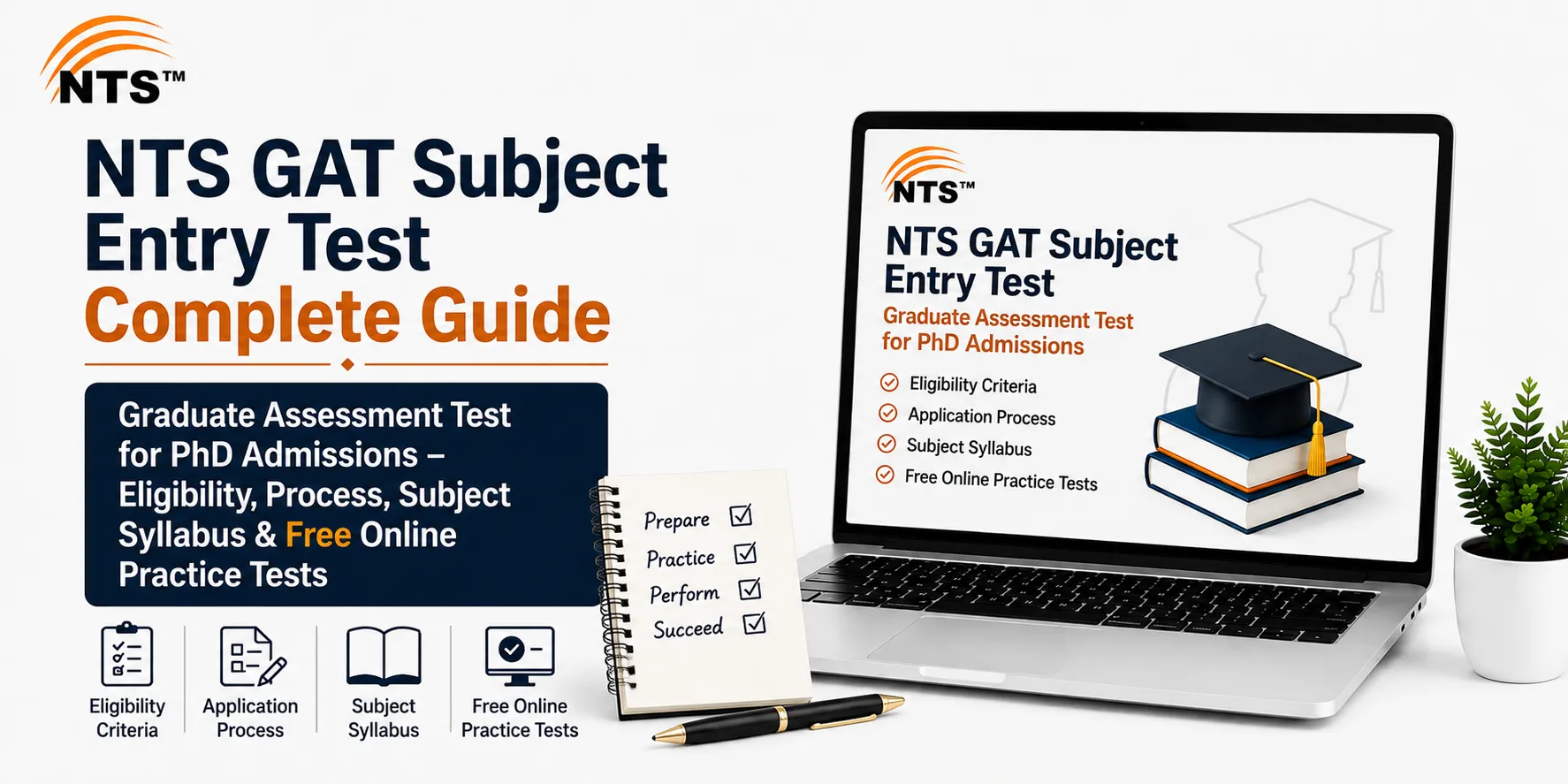
Graduate Assessment Test for PhD Admissions – Eligibility, Process, Subject Syllabus & Free Online Practice Tests
The Graduate Assessment Test (GAT) is a standardized entrance examination conducted by the National Testing Service (NTS) of Pakistan. It is a mandatory requirement for students who wish to pursue MS, M.Phil., or Ph.D. programs at recognized universities across the country.
The GAT Subject is specifically designed for candidates with 16 years of education who wish to pursue PhD programs. It assesses a candidate's aptitude across two key areas: Verbal Reasoning and Subject-Specific Knowledge.
If you are planning to apply for PhD admissions through the NTS GAT Subject, this comprehensive guide covers everything you need to know:
-
What is the NTS GAT Subject test and which programs accept it?
-
What are the GAT categories?
-
Which universities accept GAT?
-
What are the eligibility criteria?
-
How to apply for the GAT?
-
What is the test pattern and time allowed?
-
What is the complete syllabus for each subject?
-
How can I practice GAT Subject MCQs online for free?
Students who want to begin their preparation immediately can start with NTS GAT Subject Free Quiz , where hundreds of free chapter-wise quizzes are available to strengthen concepts and improve exam performance.
What is NTS?
The National Testing Service (NTS) is Pakistan's premier testing agency, established to conduct standardized tests for admissions, scholarships, and recruitment purposes. NTS is responsible for developing and administering various tests, including:
-
GAT (Graduate Assessment Test) for MS/MPhil and PhD programs
-
NAT (National Aptitude Test) for undergraduate programs
-
Other recruitment and aptitude tests
NTS ensures transparency, merit, and standardization in the admission process across Pakistani universities.
What is GAT?
The Graduate Assessment Test (GAT) is a standardized test for students seeking admission to graduate-level (MS/MPhil/PhD) programs in NTS-associated universities.
Key Features of GAT Subject
-
Validity: The GAT result is valid for two years from the date of declaration.
-
Acceptance: GAT Subject is accepted by public and private universities across Pakistan for PhD admissions.
-
Qualifying Score: Minimum score requirements vary by university (typically 50-60%).
-
Quarterly Basis: NTS conducts the GAT on a quarterly basis across major cities in Pakistan.
GAT Categories
GAT Subject is offered in 20 subject categories, each designed for a specific academic background for PhD admissions:
-
Agriculture
-
Biotechnology
-
Business Administration
-
Chemical Engineering
-
Chemistry
-
Civil Engineering
-
Computer Science
-
Economics
-
Electrical Engineering
-
English Literature
-
Environmental Sciences
-
Law
-
Mathematics
-
Mechanical Engineering
-
Physics
-
Psychology
-
Software Engineering
-
Statistics
-
Veterinary Sciences
This categorization ensures fair evaluation of students according to their academic background.
GAT Subject: Overview
The NTS GAT Subject - Aptitude Test is specifically designed for candidates with 16 years of education who wish to pursue PhD programs. It assesses knowledge and aptitude across two core areas: Verbal Reasoning and Subject-Specific Knowledge.
Applicable Programs
GAT Subject is accepted for admission to a wide range of PhD programs across various disciplines, including:
-
Agriculture & Veterinary Sciences
-
Biotechnology & Biological Sciences
-
Business Administration & Management Sciences
-
Chemical, Civil, Electrical, and Mechanical Engineering
-
Chemistry, Physics, and Mathematics
-
Computer Science & Software Engineering
-
Economics & Environmental Sciences
-
English Literature & Law
-
Psychology & Statistics
Universities Accepting GAT Subject
GAT Subject is accepted by numerous universities across Pakistan that are associated with NTS. Some of the well-known institutions that accept GAT for PhD admissions include:
-
National University of Sciences and Technology (NUST) – Requires NTS GAT (Subject) with a minimum score for PhD admissions
-
Government College University (GCU), Lahore – Requires NTS GAT (Subject) for PhD programs
-
COMSATS University – Accepts GAT (Subject) for PhD admissions
-
Air University, Islamabad – Accepts GAT Subject for admissions
-
HEC Scholarship Programs – GAT Subject is also required for HEC scholarship schemes (Local & Foreign)
Note: This is not an exhaustive list. Candidates are advised to check the official admission advertisement of their desired university to confirm GAT acceptance.
GAT Subject Eligibility Criteria
The eligibility criteria for GAT Subject are clearly defined by NTS:
Educational Requirements
-
16 years of education (Bachelor's or Master's degree or equivalent)
-
Candidates with A-Level or equivalent qualifications must have IBCC equivalence certificate
-
Candidates interested in pursuing a PhD degree in Pakistani universities
Age Requirements
-
No specific age limit is prescribed by NTS
-
Candidates must meet the age requirements of the university they are applying to
Domicile Requirements
-
Candidates from all provinces of Pakistan can apply
-
Some universities may have specific domicile requirements – check the university's admission policy
Test Validity
-
The GAT score is valid for two years from the date of result declaration
Other Requirements
-
Candidates must have a valid CNIC/B-Form and a recent passport-size photograph
-
Candidates must register online through the NTS Candidate Portal
GAT Subject Application Process
The application process for GAT Subject is conducted online through the NTS Candidate Portal with no manual applications accepted.
Step-by-Step Application Guide
-
Visit the Official NTS Website: www.nts.org.pk
-
Create an Account: Click on the NTS Candidate Portal. Register with your CNIC or Passport Number and create a password. Complete your personal profile.
-
Upload Photograph: Upload a recent passport-size photograph with a blue background and a scanned copy of your CNIC.
-
Select the Test: Choose the appropriate GAT Subject test from the list of projects announced in the NTS online Registration Portal. Select your subject from the available list.
-
Pay the Application Fee: Download the GAT bank deposit slip from the NTS online Registration Portal. Deposit the non-refundable and non-transferable test processing fee through designated banks. The fee is typically PKR 2,500 + service charges.
-
Submit Application: Review all information before final submission. Submit the online application form.
-
Download Roll Number Slip: Roll Number Slips are available for download via the NTS portal before the test date. Print the slip and bring it to the test center.
Important Notice
Ensure that personal metrics (Name, CNIC, Mobile Number) match your legal documentation perfectly. Mobile phones are not allowed in test center premises.
Test Schedule
NTS conducts the GAT Subject on a quarterly basis across major cities in Pakistan. Test dates are announced on the official NTS website www.nts.org.pk .
Dates are subject to change. Always verify exact dates and procedures on the official NTS website.
GAT Subject Test Pattern
The GAT Subject is a paper-based exam consisting of multiple-choice questions (MCQs) . The test is conducted in English.
Test Pattern Overview
-
Total MCQs: 100
-
Time Allowed: 120 minutes (2 hours)
-
Total Marks: 100
-
Test Mode: Paper-Based
-
Negative Marking: Yes (-0.25 for wrong answers)
Section-Wise Breakdown
-
Verbal Reasoning: 30% weightage
-
Subject-Specific Portion: 70% weightage
GAT Subject Syllabus
The GAT Subject syllabus consists of Verbal Reasoning and Subject-Specific Knowledge. Below is the chapter-wise breakdown for each subject.
Start your preparation with NTS GAT Subject - Aptitude Test Practice .
Verbal Reasoning English
The Verbal Reasoning section evaluates English language understanding and reading comprehension. Start your preparation with GAT Subject - Verbal Reasoning Practice Tests .
The Verbal Reasoning syllabus includes:
-
Reading Comprehension – Reading comprehension passages
1. Agriculture
The Agriculture section covers a wide range of topics from agricultural sciences. Start your preparation with GAT Subject - Agriculture Practice Tests .
The Agriculture syllabus includes:
-
Agricultural Economics
-
Agronomy
-
Crop Physiology
-
Entomology
-
Horticulture
-
Irrigation and Water Management
-
Plant Breeding
-
Plant Pathology
-
Seed Science
-
Soil Science
2. Biotechnology
The Biotechnology section covers a wide range of topics from biotechnology sciences. Start your preparation with GAT Subject - Biotechnology Practice Tests .
The Biotechnology syllabus includes:
-
Biochemistry
-
Bioinformatics
-
Cell Biology
-
Genetic Engineering
-
Genetics
-
Immunology
-
Industrial Biotechnology
-
Microbiology
-
Molecular Biology
-
Plant Biotechnology
3. Business Administration
The Business Administration section covers core business and management concepts. Start your preparation with GAT Subject - Business Administration Practice Tests .
The Business Administration syllabus includes:
-
Accounting Fundamentals
-
Business Economics
-
Business Research Methods
-
Financial Management
-
Human Resource Management
-
Marketing Management
-
Operations and Production Management
-
Organizational Behavior
-
Principles of Management
-
Strategic Management
4. Chemical Engineering
The Chemical Engineering section covers core chemical engineering concepts. Start your preparation with GAT Subject - Chemical Engineering Practice Tests .
The Chemical Engineering syllabus includes:
-
Chemical Plant Design
-
Chemical Process Principles
-
Chemical Reaction Engineering
-
Fluid Mechanics
-
Heat Transfer
-
Mass Transfer
-
Process Control
-
Process Thermodynamics
-
Separation Processes
-
Transport Phenomena
5. Chemistry
The Chemistry section covers a wide range of chemistry topics. Start your preparation with GAT Subject - Chemistry Practice Tests .
The Chemistry syllabus includes:
-
Analytical Chemistry
-
Chemical Kinetics
-
Chemical Thermodynamics
-
Coordination Chemistry
-
Electrochemistry
-
Environmental Chemistry
-
Inorganic Chemistry
-
Organic Chemistry
-
Physical Chemistry
-
Spectroscopy
6. Civil Engineering
The Civil Engineering section covers core civil engineering concepts. Start your preparation with GAT Subject - Civil Engineering Practice Tests .
The Civil Engineering syllabus includes:
-
Building Materials
-
Construction Management
-
Environmental Engineering
-
Fluid Mechanics
-
Geotechnical Engineering
-
Structural Analysis
-
Structural Design
-
Surveying
-
Transportation Engineering
-
Water Resources Engineering
7. Computer Science
The Computer Science section covers core computing topics. Start your preparation with GAT Subject - Computer Science Practice Tests .
The Computer Science syllabus includes:
-
Algorithms
-
Computer Organization and Architecture
-
Data Structures
-
Operating Systems
-
Web Technologies
8. Economics
The Economics section covers a wide range of economic concepts. Start your preparation with GAT Subject - Economics Practice Tests .
The Economics syllabus includes:
-
Consumer Theory
-
Development Economics
-
Econometrics
-
International Economics
-
Macroeconomics
-
Market Structures
-
Microeconomics
-
Monetary Economics
-
Producer Theory
-
Public Finance
9. Electrical Engineering
The Electrical Engineering section covers core electrical and electronics concepts. Start your preparation with GAT Subject - Electrical Engineering Practice Tests .
The Electrical Engineering syllabus includes:
-
Circuit Analysis
-
Communication Systems
-
Control Systems
-
Digital Logic Design
-
Electrical Machines
-
Electromagnetic Fields (EMFT)
-
Electronics (Analog & Digital)
-
Power Electronics
-
Power Systems
-
Signals & Systems
10. English Literature
The English Literature section covers a wide range of literary topics. Start your preparation with GAT Subject - English Literature Practice Tests .
The English Literature syllabus includes:
-
American Literature
-
Drama
-
Literary Criticism
-
Literary Theory
-
Modern Literature
-
Novel
-
Poetry
-
Prose
-
Romantic Literature
-
Victorian Literature
11. Environmental Sciences
The Environmental Sciences section covers a wide range of environmental topics. Start your preparation with GAT Subject - Environmental Sciences Practice Tests .
The Environmental Sciences syllabus includes:
-
Biodiversity Conservation
-
Climate Change
-
Environmental Chemistry
-
Environmental Ecology
-
Environmental Impact Assessment
-
Environmental Policy
-
Environmental Pollution
-
Natural Resource Management
-
Waste Management
-
Water Resource Management
12. Law
The Law section covers a wide range of legal topics. Start your preparation with GAT Subject - Law Practice Tests .
The Law syllabus includes:
-
Civil Procedure
-
Constitutional Law
-
Contract Law
-
Criminal Law
-
Criminal Procedure
-
International Law
-
Islamic Law
-
Jurisprudence
-
Law of Torts
-
Legal Research Methods
13. Mathematics
The Mathematics section covers a wide range of mathematical topics. Start your preparation with GAT Subject - Mathematics Practice Tests .
The Mathematics syllabus includes:
-
Abstract Algebra
-
Calculus
-
Complex Analysis
-
Differential Equations
-
Linear Algebra
-
Numerical Analysis
-
Probability Theory
-
Real Analysis
-
Statistics
-
Vector Calculus
14. Mechanical Engineering
The Mechanical Engineering section covers core mechanical engineering concepts. Start your preparation with GAT Subject - Mechanical Engineering Practice Tests .
The Mechanical Engineering syllabus includes:
-
Engineering Materials
-
Engineering Mechanics
-
Fluid Mechanics
-
Heat Transfer
-
Internal Combustion Engines and Power Plants
-
Manufacturing Processes
-
Mechanical Vibrations and Control Systems
-
Mechanics of Materials
-
Theory of Machines and Machine Design
-
Thermodynamics
15. Physics
The Physics section covers a wide range of physics topics. Start your preparation with GAT Subject - Physics Practice Tests .
The Physics syllabus includes:
-
Atomic Physics
-
Classical Mechanics
-
Electromagnetism
-
Nuclear Physics
-
Optics
-
Quantum Mechanics
-
Solid State Physics
-
Statistical Physics
-
Thermodynamics
-
Waves and Oscillations
16. Psychology
The Psychology section covers a wide range of psychological concepts. Start your preparation with GAT Subject - Psychology Practice Tests .
The Psychology syllabus includes:
-
Abnormal Psychology
-
Clinical Psychology
-
Cognitive Psychology
-
Developmental Psychology
-
Introduction to Psychology
-
Learning and Memory
-
Personality Psychology
-
Psychological Testing
-
Research Methods
-
Social Psychology
17. Software Engineering
The Software Engineering section covers core software engineering concepts. Start your preparation with GAT Subject - Software Engineering Practice Tests .
The Software Engineering syllabus includes:
-
Agile Software Development and DevOps
-
Object-Oriented Analysis and Design
-
Software Configuration Management
-
Software Design and Architecture
-
Software Development Life Cycle
-
Software Engineering
-
Software Engineering Fundamentals
-
Software Maintenance and Evolution
-
Software Project Management
-
Software Requirements Engineering
-
Software Testing and Quality Assurance
18. Statistics
The Statistics section covers a wide range of statistical concepts. Start your preparation with GAT Subject - Statistics Practice Tests .
The Statistics syllabus includes:
-
Descriptive Statistics
-
Experimental Design
-
Hypothesis Testing
-
Multivariate Statistics
-
Probability Distributions
-
Probability Theory
-
Regression Analysis
-
Sampling Techniques
-
Statistical Inference
-
Time Series Analysis
19. Veterinary Sciences
The Veterinary Sciences section covers a wide range of veterinary topics. Start your preparation with GAT Subject - Veterinary Sciences Practice Tests .
The Veterinary Sciences syllabus includes:
-
Animal Nutrition
-
Animal Reproduction
-
Veterinary Anatomy
-
Veterinary Biochemistry
-
Veterinary Medicine
-
Veterinary Microbiology
-
Veterinary Pathology
-
Veterinary Pharmacology
-
Veterinary Physiology
-
Veterinary Surgery
GAT Subject Merit Calculation
The final merit for GAT-based admissions is determined by universities based on their specific admission policies. Generally, the merit formula includes:
-
GAT Test Score: Significant weightage (minimum scores vary by university: 50-60%)
-
Graduate (16 years) Marks: Weightage as per university policy
-
Interview/Entry Test: As per university policy
Minimum Score Requirements:
-
NUST: Overall Score >= 60%
-
Other Universities: Typically 50% or above
Different universities have different merit criteria. Some universities may give higher weightage to the GAT score, while others may prioritize academic marks.
GAT Subject Preparation Tips
-
Understand the Test Pattern: GAT Subject consists of MCQs covering Verbal Reasoning and Subject-Specific Knowledge. The subject-specific portion carries 70% weightage, so focus heavily on your subject.
-
Know the Syllabus Thoroughly: Familiarize yourself with the complete chapter-wise syllabus for your subject. Use the chapter lists above as a checklist to ensure you cover every topic.
-
Practice Chapter by Chapter: Complete one chapter at a time and immediately attempt the relevant chapter-wise quiz. The free quizzes on Pak Admissions are designed specifically for this purpose.
-
Focus on High-Yield Topics:
-
Verbal Reasoning: Reading comprehension
-
Subject-Specific: Focus on your core subject areas based on your academic background
-
-
Take Full-Length Mock Tests: Take full-length mock tests under timed conditions (120 minutes) to improve your time management skills and build stamina.
-
Manage Negative Marking: There is a negative marking of -0.25 for each wrong answer. Avoid random guessing.
-
Start Early: Begin your preparation well in advance. Don't wait until the last month. Starting early gives you the best results.
-
Use Official NTS Resources: Visit the official NTS website www.nts.org.pk for the latest updates, test schedules, and sample papers.
Frequently Asked Questions (FAQs)
-
What is the difference between GAT General and GAT Subject?
-
GAT General is for MS/MPhil admissions and consists of 100% aptitude (Verbal + Analytical + Quantitative Reasoning). GAT Subject is for PhD admissions and includes 30% aptitude (Verbal Reasoning) and 70% subject-specific questions.
-
-
Which test should I take for PhD admissions?
-
You should take GAT Subject for PhD admissions. Choose the subject that matches your academic background.
-
-
Is there negative marking in GAT Subject?
-
Yes, there is a negative marking of -0.25 for each wrong answer.
-
-
What is the qualifying score for GAT Subject?
-
Minimum scores vary by university (typically 50-60%). NUST requires 60%.
-
-
How long is the GAT score valid?
-
The GAT score is valid for two years from the date of result declaration.
-
-
Can I take the GAT test multiple times?
-
Yes, you can appear for the GAT test multiple times as it is conducted on a quarterly basis.
-
-
How can I practice for GAT Subject?
-
You can practice for free on Pak Admissions . The platform offers comprehensive MCQs covering all subjects.
-
-
Which universities accept GAT Subject?
-
GAT Subject is accepted by numerous HEC-recognized universities across Pakistan, including NUST, GCU Lahore, COMSATS, Air University, and many others.
-
Final Words
NTS GAT Subject is your gateway to a wide range of PhD programs at top universities across Pakistan. With the right preparation strategy and consistent practice, you can achieve a qualifying score and secure admission to your desired program. Start your preparation today by exploring the chapter-wise practice quizzes available on Pak Admissions .
Good luck with your GAT Subject preparation!