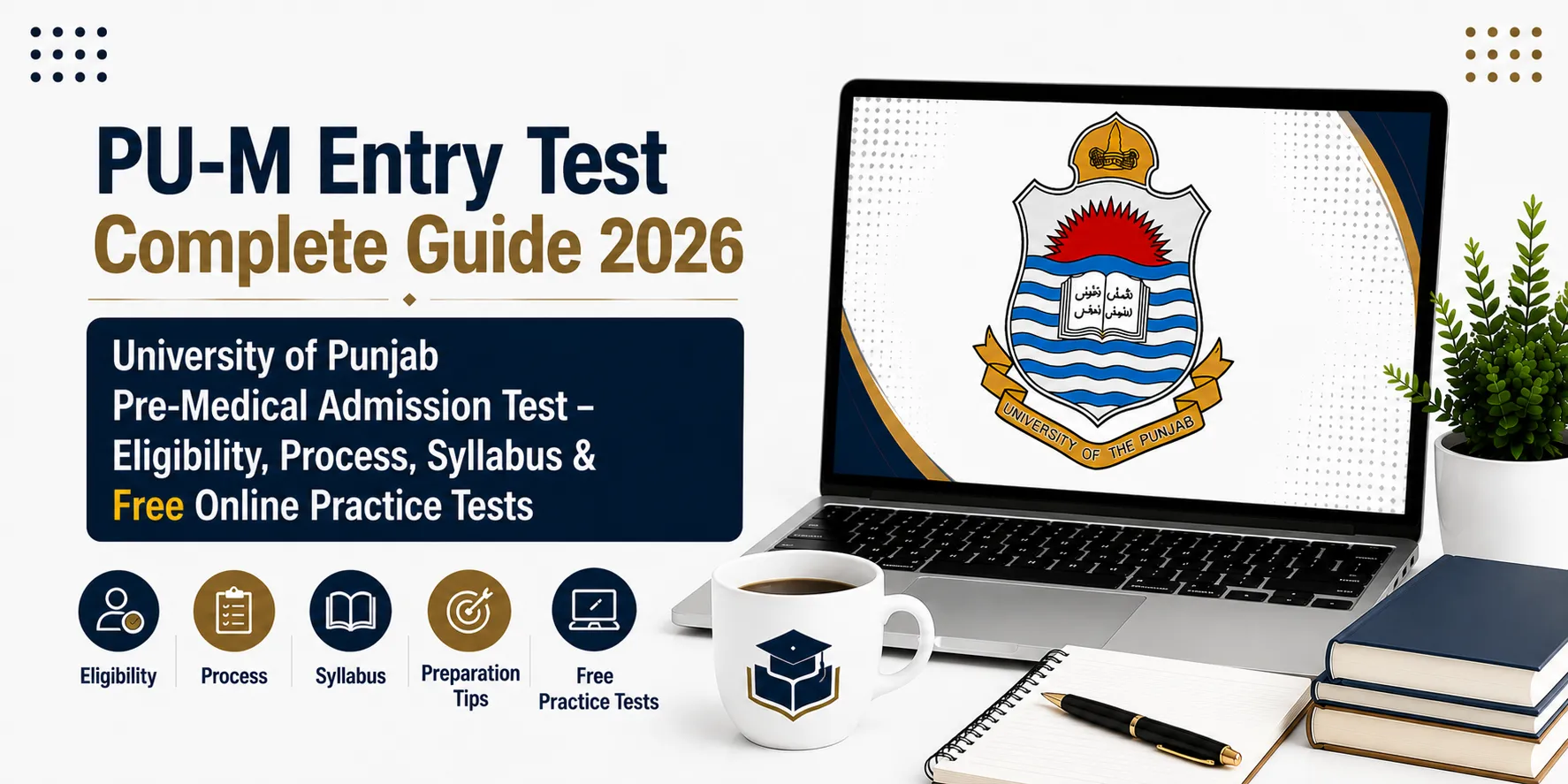
PU-M Entry Test Complete Guide 2026
University of Punjab Pre-Medical Admission Test – Eligibility, Process, Syllabus & Free Online Practice Tests
The University of the Punjab (PU) , one of Pakistan's oldest and most prestigious institutions, has made the PU Admission Test mandatory for all undergraduate admissions for the 2026-27 academic year. The PU-M (Pre-Medical) category is specifically designed for students who have completed their intermediate education in Pre-Medical and wish to pursue undergraduate degrees in Medicine, Pharmacy, and related fields.
If you are planning to apply for undergraduate programs through the PU-M category, this comprehensive guide covers everything you need to know:
-
What is the PU-M Entry Test and which programs accept it?
-
What are the eligibility criteria?
-
How to apply for the PU-M test?
-
What is the test pattern and time allowed?
-
What is the complete syllabus?
-
How can I practice PU-M MCQs online for free?
Students who want to begin their preparation immediately can start with PU-M Entry Test Free Quizzes , where hundreds of free chapter-wise quizzes are available to strengthen concepts and improve exam performance.
What is PU-M?
The PU-M (Pre-Medical) is one of the seven categories of the PU Admission Test conducted by the University of the Punjab for undergraduate admissions. It is designed for students who have completed their intermediate education in Pre-Medical and wish to pursue undergraduate degrees in Medicine, Pharmacy, and related disciplines.
Key Features of PU-M
-
Mandatory Test: The PU Admission Test is mandatory for all undergraduate admissions
-
25% Merit Weightage: The test carries a 25% weightage in the total merit calculation
-
Seven Categories: The test is conducted in seven categories based on academic streams
-
Multiple Cities: The test is held in major cities across Pakistan
-
Test Validity: Scores from previous admission tests are not valid for the upcoming admission cycle
-
Multiple Attempts: Students can appear in both the 1st and 2nd tests, and the higher score will be used for admission
Programs Accepting PU-M
PU-M is accepted for admission to a wide range of Bachelor's (4-year) programs in Medicine and related fields. Common programs include:
-
Doctor of Pharmacy (Pharm-D) – MDCAT or PU Admission Test is valid for admission
-
BS Medical Laboratory Technology
-
BS Nursing
-
BS Public Health
-
BS Nutrition & Dietetics
-
BS Biotechnology
-
BS Microbiology
-
BS Biochemistry
-
BS Genetics
-
BS Environmental Science
-
And other Pre-Medical related undergraduate programs
Note: Students with Pre-Engineering background should apply under the PU-E category, ICS with Statistics/Physics under the PU-CSS/PU-CSP categories, and Arts, Humanities & Social Sciences under the PU-AHS category.
PU-M Eligibility Criteria
The eligibility criteria for PU-M are clearly defined by the University of the Punjab:
Educational Requirements
-
12 years of education (Intermediate / HSSC) or equivalent
-
Pre-Medical or equivalent background is required for this category
-
Candidates with A-Level or equivalent qualifications must have IBCC equivalence certificate
-
Students who have appeared in the final examination of HSSC or equivalent and are awaiting results can also apply
Age Requirements
-
Candidates holding F.A/F.Sc or equivalent qualification with not more than 24 years of age shall be eligible
-
Candidates must meet the age requirements of the specific program they are applying to
Domicile Requirements
-
Candidates from all provinces of Pakistan can apply
-
Some programs may have specific domicile requirements – check the university's admission policy
Test Validity
-
Scores from previous admission tests are not valid for the upcoming admission cycle
Other Requirements
-
Candidates must have a valid CNIC/B-Form and a recent passport-size photograph
-
Candidates must register online through the PU Admission Test Portal
PU-M Application Process
The application process for PU-M is conducted online through the PU Admission Test Portal.
Step-by-Step Application Guide
-
Visit the Official PU Admission Test Portal: admissiontest.pu.edu.pk
-
Register Online: Fill in your personal details, academic information, and CNIC/B-Form number
-
Select Test Category: Choose PU-M (Pre-Medical) from the available categories
-
Download Fee Challan: Download the system-generated fee challan while registering
-
Pay the Application Fee: The test fee is PKR 2,500 (non-refundable and non-transferable). Pay at any branch of HBL, UBL, or through mobile banking (1Bill)
-
Upload Proof of Payment: Upload an image of the proof of payment on the portal to complete the application process
-
Submit Application: Review all information before final submission. Incomplete applications will be rejected
-
Download Roll Number Slip: Download your Roll No. Slip through the link available on the Admission Test Portal before the test date
Important Dates (2026 Session)
-
1st Entry Test Registration Deadline: May 25, 2026
-
1st Entry Test Date: June 14, 2026 (Sunday)
-
2nd Entry Test Registration Deadline: July 03, 2026
-
2nd Entry Test Date: July 19, 2026 (Sunday)
Dates are subject to change. Always verify exact dates and procedures on the official PU Admission Test Portal.
Required Documents on Test Day
-
Roll No. Slip (printed copy)
-
Attested copy of Matric/SSC Certificate
-
Proof of payment
-
Valid CNIC/B-Form
PU-M Test Pattern
The PU-M Admission Test consists of 100 multiple-choice questions (MCQs) with a specific section-wise breakdown.
Test Pattern Overview
-
Total MCQs: 100
-
Total Marks: 100
-
Test Mode: Paper-Based (conducted in major cities across Pakistan)
-
Negative Marking: None
-
Test Weightage: 25% of the total merit calculation
-
Test Validity: Valid only for the current admission cycle
Section-Wise Breakdown for PU-M
Section Number of Questions Marks Verbal Reasoning (English) 20 20% Quantitative Reasoning 20 20% Subject-1 (Biology) 20 20% Subject-2 (Chemistry) 20 20% Subject-3 (Physics) 20 20%PU-M Syllabus
The PU-M syllabus consists of five sections: English (Verbal Reasoning), Quantitative Reasoning, Biology, Chemistry, and Physics.
Start your preparation with PU-M Entry Test Free Quizzes .
English / Verbal Reasoning
The English section evaluates grammar, vocabulary, and comprehension skills. Start your preparation with PU-M English Practice Tests .
The English syllabus includes:
-
Antonyms – Words with opposite meanings
-
Free Quiz 1 – Free Quiz 2 – Free Quiz 3
-
-
Comprehension – Reading comprehension passages
-
Free Quiz 1 – Free Quiz 2 – Free Quiz 3
-
-
Parts of Speech – Nouns, verbs, adjectives, adverbs, etc.
-
Free Quiz 1 – Free Quiz 2 – Free Quiz 3
-
-
Subject Verb Agreement – Grammar rules for subject-verb agreement
-
Free Quiz 1 – Free Quiz 2 – Free Quiz 3
-
-
Synonyms – Words with similar meanings
-
Free Quiz 1 – Free Quiz 2 – Free Quiz 3
-
-
Tenses – Present, past, and future tenses
-
Free Quiz 1 – Free Quiz 2 – Free Quiz 3
-
-
Word Usage – Correct usage of words in sentences
-
Free Quiz 1 – Free Quiz 2 – Free Quiz 3
-
Quantitative Reasoning
The Quantitative Reasoning section tests basic mathematical skills. Start your preparation with PU-M Quantitative Reasoning Practice Tests .
The Quantitative Reasoning syllabus includes:
-
Algebra – Basic algebraic concepts and equations
-
Free Quiz 1 – Free Quiz 2 – Free Quiz 3
-
-
Arithmetic – Basic arithmetic operations, percentages, ratios
-
Free Quiz 1 – Free Quiz 2 – Free Quiz 3
-
-
Geometry and Mensuration – Basic geometry and measurements
-
Free Quiz 1 – Free Quiz 2 – Free Quiz 3
-
Biology
The Biology section is the most important section for PU-M candidates. Start your preparation with PU-M Biology Practice Tests .
The Biology syllabus includes:
-
Biodiversity – Classification of living organisms
-
Free Quiz 1 – Free Quiz 2 – Free Quiz 3
-
-
Bioenergetics – Photosynthesis, respiration, energy metabolism
-
Free Quiz 1 – Free Quiz 2 – Free Quiz 3
-
-
Biological Molecules – Carbohydrates, proteins, lipids, nucleic acids
-
Free Quiz 1 – Free Quiz 2 – Free Quiz 3
-
-
Biotechnology – Genetic engineering, cloning, DNA technology
-
Free Quiz 1 – Free Quiz 2 – Free Quiz 3
-
-
Cell Cycle – Mitosis, meiosis, cell cycle regulation
-
Free Quiz 1 – Free Quiz 2 – Free Quiz 3
-
-
Cell Structure and Function – Cell organelles, cell membrane, cell division
-
Free Quiz 1 – Free Quiz 2 – Free Quiz 3
-
-
Chromosomes and DNA – DNA structure, chromosomes, genes
-
Free Quiz 1 – Free Quiz 2 – Free Quiz 3
-
-
Coordination and Control – Nervous system, hormones, reflexes
-
Free Quiz 1 – Free Quiz 2 – Free Quiz 3
-
-
Ecosystem – Ecosystem structure, energy flow, nutrient cycles
-
Free Quiz 1 – Free Quiz 2 – Free Quiz 3
-
-
Evolution – Theories of evolution, natural selection
-
Free Quiz 1 – Free Quiz 2 – Free Quiz 3
-
-
Gas Exchange – Respiratory system, gas exchange mechanisms
-
Free Quiz 1 – Free Quiz 2 – Free Quiz 3
-
-
Growth and Development – Growth patterns, development stages
-
Free Quiz 1 – Free Quiz 2 – Free Quiz 3
-
-
Homeostasis – Osmoregulation, thermoregulation, excretion
-
Free Quiz 1 – Free Quiz 2 – Free Quiz 3
-
-
Introduction to Biology – Branches of biology, scientific method
-
Free Quiz 1 – Free Quiz 2 – Free Quiz 3
-
-
Kingdom Animalia – Animal classification, characteristics
-
Free Quiz 1 – Free Quiz 2 – Free Quiz 3
-
-
Kingdom Plantae – Plant classification, characteristics
-
Free Quiz 1 – Free Quiz 2 – Free Quiz 3
-
-
Man and His Environment – Human impact on environment, conservation
-
Free Quiz 1 – Free Quiz 2 – Free Quiz 3
-
-
Nutrition – Types of nutrition, digestive system
-
Free Quiz 1 – Free Quiz 2 – Free Quiz 3
-
-
Reproduction – Asexual and sexual reproduction, human reproduction
-
Free Quiz 1 – Free Quiz 2 – Free Quiz 3
-
-
Some Major Ecosystems – Forest, desert, aquatic ecosystems
-
Free Quiz 1 – Free Quiz 2 – Free Quiz 3
-
-
Support and Movement – Skeletal system, muscles, locomotion
-
Free Quiz 1 – Free Quiz 2 – Free Quiz 3
-
-
Transport – Circulatory system, transport in plants
-
Free Quiz 1 – Free Quiz 2 – Free Quiz 3
-
-
Variation and Genetics – Mendelian genetics, inheritance patterns
-
Free Quiz 1 – Free Quiz 2 – Free Quiz 3
-
Chemistry
The Chemistry section covers physical, inorganic, and organic chemistry. Start your preparation with PU-M Chemistry Practice Tests .
The Chemistry syllabus includes:
-
Alcohols and Phenols – Alcohols, phenols, ethers
-
Free Quiz 1 – Free Quiz 2 – Free Quiz 3
-
-
Aldehydes and Ketones – Aldehydes, ketones, reactions
-
Free Quiz 1 – Free Quiz 2 – Free Quiz 3
-
-
Aliphatic Hydrocarbons – Alkanes, alkenes, alkynes
-
Free Quiz 1 – Free Quiz 2 – Free Quiz 3
-
-
Alkyl Halides – Haloalkanes, reactions
-
Free Quiz 1 – Free Quiz 2 – Free Quiz 3
-
-
Aromatic Hydrocarbons – Benzene and derivatives
-
Free Quiz 1 – Free Quiz 2 – Free Quiz 3
-
-
Basic Concepts – Stoichiometry, mole concept
-
Free Quiz 1 – Free Quiz 2 – Free Quiz 3
-
-
Carboxylic Acids – Carboxylic acids, derivatives
-
Free Quiz 1 – Free Quiz 2 – Free Quiz 3
-
-
Chemical Bonding – Ionic, covalent, metallic bonds
-
Free Quiz 1 – Free Quiz 2 – Free Quiz 3
-
-
Chemical Equilibrium – Equilibrium constant, Le Chatelier's principle
-
Free Quiz 1 – Free Quiz 2 – Free Quiz 3
-
-
Common Chemical Industries in Pakistan – Industrial processes, fertilizers, polymers
-
Free Quiz 1 – Free Quiz 2 – Free Quiz 3
-
-
Electrochemistry – Electrochemical cells, electrolysis
-
Free Quiz 1 – Free Quiz 2 – Free Quiz 3
-
-
Experimental Techniques – Laboratory techniques, analysis
-
Free Quiz 1 – Free Quiz 2 – Free Quiz 3
-
-
Fundamental Principles of Organic Chemistry – Organic chemistry basics, functional groups
-
Free Quiz 1 – Free Quiz 2 – Free Quiz 3
-
-
Gases – Gas laws, kinetic molecular theory
-
Free Quiz 1 – Free Quiz 2 – Free Quiz 3
-
-
Liquids – Properties of liquids, vapor pressure
-
Free Quiz 1 – Free Quiz 2 – Free Quiz 3
-
-
Macromolecules – Polymers, biomolecules
-
Free Quiz 1 – Free Quiz 2 – Free Quiz 3
-
-
Reaction Kinetics – Rate of reaction, factors affecting rate
-
Free Quiz 1 – Free Quiz 2 – Free Quiz 3
-
-
S Block Elements – Groups IA-IIA elements
-
Free Quiz 1 – Free Quiz 2 – Free Quiz 3
-
-
Solids – Crystalline and amorphous solids
-
Free Quiz 1 – Free Quiz 2 – Free Quiz 3
-
-
Thermochemistry – Enthalpy, entropy, Gibbs free energy
-
Free Quiz 1 – Free Quiz 2 – Free Quiz 3
-
Physics
The Physics section covers core physical concepts. Start your preparation with PU-M Physics Practice Tests .
The Physics syllabus includes:
-
Alternating Current – AC circuits, resonance
-
Free Quiz 1 – Free Quiz 2 – Free Quiz 3
-
-
Atomic Spectra – Atomic spectra, Bohr's model
-
Free Quiz 1 – Free Quiz 2 – Free Quiz 3
-
-
Current Electricity – Ohm's law, circuits, resistivity
-
Free Quiz 1 – Free Quiz 2 – Free Quiz 3
-
-
Dawn of Modern Physics – Relativity, quantum theory
-
Free Quiz 1 – Free Quiz 2 – Free Quiz 3
-
-
Electromagnetic Induction – Faraday's law, Lenz's law
-
Free Quiz 1 – Free Quiz 2 – Free Quiz 3
-
-
Electromagnetism – Magnetic fields, forces on moving charges
-
Free Quiz 1 – Free Quiz 2 – Free Quiz 3
-
-
Electronics – Semiconductors, diodes, transistors
-
Free Quiz 1 – Free Quiz 2 – Free Quiz 3
-
-
Electrostatics – Coulomb's law, electric fields
-
Free Quiz 1 – Free Quiz 2 – Free Quiz 3
-
-
Fluid Dynamics – Bernoulli's equation, viscosity
-
Free Quiz 1 – Free Quiz 2 – Free Quiz 3
-
-
Geometrical Optics – Reflection, refraction, lenses
-
Free Quiz 1 – Free Quiz 2 – Free Quiz 3
-
-
Measurements – SI Units, errors, physical quantities
-
Free Quiz 1 – Free Quiz 2 – Free Quiz 3
-
-
Motion and Force – Newton's laws, kinematics, dynamics
-
Free Quiz 1 – Free Quiz 2 – Free Quiz 3
-
-
Nuclear Physics – Radioactivity, nuclear reactions
-
Free Quiz 1 – Free Quiz 2 – Free Quiz 3
-
-
Oscillations – Simple harmonic motion
-
Free Quiz 1 – Free Quiz 2 – Free Quiz 3
-
-
Physical Optics – Interference, diffraction, polarization
-
Free Quiz 1 – Free Quiz 2 – Free Quiz 3
-
-
Rotational and Circular Motion – Torque, angular momentum
-
Free Quiz 1 – Free Quiz 2 – Free Quiz 3
-
-
Vectors and Equilibrium – Vectors, equilibrium conditions
-
Free Quiz 1 – Free Quiz 2 – Free Quiz 3
-
-
Waves – Wave properties, wave motion
-
Free Quiz 1 – Free Quiz 2 – Free Quiz 3
-
-
Work and Energy – Work, power, energy conservation
-
Free Quiz 1 – Free Quiz 2 – Free Quiz 3
-
PU-M Merit Calculation
The final merit for PU-M-based admissions is determined by the university based on its specific admission policies. The merit formula includes:
-
PU Admission Test Score: 25% weightage
-
Intermediate (HSSC) Marks: Weightage as per university policy
-
Matric (SSC) Marks: Weightage as per university policy
Note: The Admission Test qualifies the candidate to apply on the portal for admission to various programs when they are advertised. Scores from previous admission tests are not valid for the upcoming admission cycle. Students can appear in both the 1st and 2nd tests, and the higher score will be used for admission.
PU-M Preparation Tips
-
Understand the Test Pattern: PU-M consists of 100 MCQs covering English (20%), Quantitative Reasoning (20%), Biology (20%), Chemistry (20%), and Physics (20%).
-
Know the Syllabus Thoroughly: Familiarize yourself with the complete chapter-wise syllabus. Detailed syllabus and marks distribution are available on the official portal.
-
Practice Chapter by Chapter: Complete one chapter at a time and immediately attempt the relevant chapter-wise quiz. The free quizzes on Pak Admissions are designed specifically for this purpose, with three free quizzes available for each chapter.
-
Focus on High-Yield Topics:
-
Biology: Genetics, bioenergetics, human physiology, and cell biology are frequently tested
-
Chemistry: Organic chemistry, chemical bonding, and electrochemistry form the core
-
Physics: Mechanics, waves, optics, and electricity are key areas
-
Quantitative Reasoning: Arithmetic, algebra, and basic geometry
-
Verbal Reasoning: Vocabulary, grammar, and comprehension
-
-
Take Full-Length Mock Tests: Take full-length mock tests under timed conditions to improve your time management skills and build stamina.
-
Analyze Your Mistakes: Review every mistake. Understanding why you got a question wrong is how you truly learn and avoid repeating the same errors.
-
Start Early: Begin your preparation well in advance. Don't wait until the last month. Starting early gives you the best results.
-
Appear in Both Tests: Students who appeared in the 1st Admission Test may also apply for the second one, and the higher score will be used for admission.
-
Use Official PU Resources: Visit the official PU Admission Test Portal admissiontest.pu.edu.pk for the latest updates, test schedules, and guidelines.
Frequently Asked Questions (FAQs)
-
What is the PU-M Entry Test?
-
The PU-M (Pre-Medical) Entry Test is one of the seven categories of the PU Admission Test conducted by the University of the Punjab for undergraduate medical admissions.
-
-
Is the PU Admission Test mandatory for all applicants?
-
Yes, the PU Admission Test is mandatory for all undergraduate admissions.
-
-
What is the test pattern for the PU-M Entry Test?
-
The test consists of 100 MCQs: English (20), Quantitative Reasoning (20), Biology (20), Chemistry (20), and Physics (20).
-
-
What is the weightage of the PU Admission Test in merit?
-
The test carries a 25% weightage in the total merit calculation.
-
-
How long is the PU Admission Test score valid?
-
Scores from previous admission tests are not valid for the upcoming admission cycle.
-
-
Can I take the PU Admission Test multiple times?
-
Yes, two tests are conducted. Students can appear in both, and the higher score will be used for admission.
-
-
How can I practice for the PU-M Entry Test?
-
You can practice for free on Pak Admissions . The platform offers comprehensive MCQs covering all subjects with three free quizzes per chapter.
-
-
Which programs accept PU-M?
-
PU-M is accepted for Doctor of Pharmacy (Pharm-D), BS Medical Laboratory Technology, BS Nursing, BS Public Health, BS Nutrition & Dietetics, and other Pre-Medical related programs.
-
-
What is the application fee for the PU Admission Test?
-
The test fee is PKR 2,500 (non-refundable and non-transferable).
-
Final Words
The PU-M Entry Test is your gateway to a wide range of undergraduate programs in Medicine, Pharmacy, and related fields at the University of the Punjab – one of Pakistan's most prestigious institutions. With the right preparation strategy and consistent practice, you can achieve a qualifying score and secure admission to your desired program. Start your preparation today by exploring the chapter-wise practice quizzes available on Pak Admissions .
Good luck with your PU-M preparation!