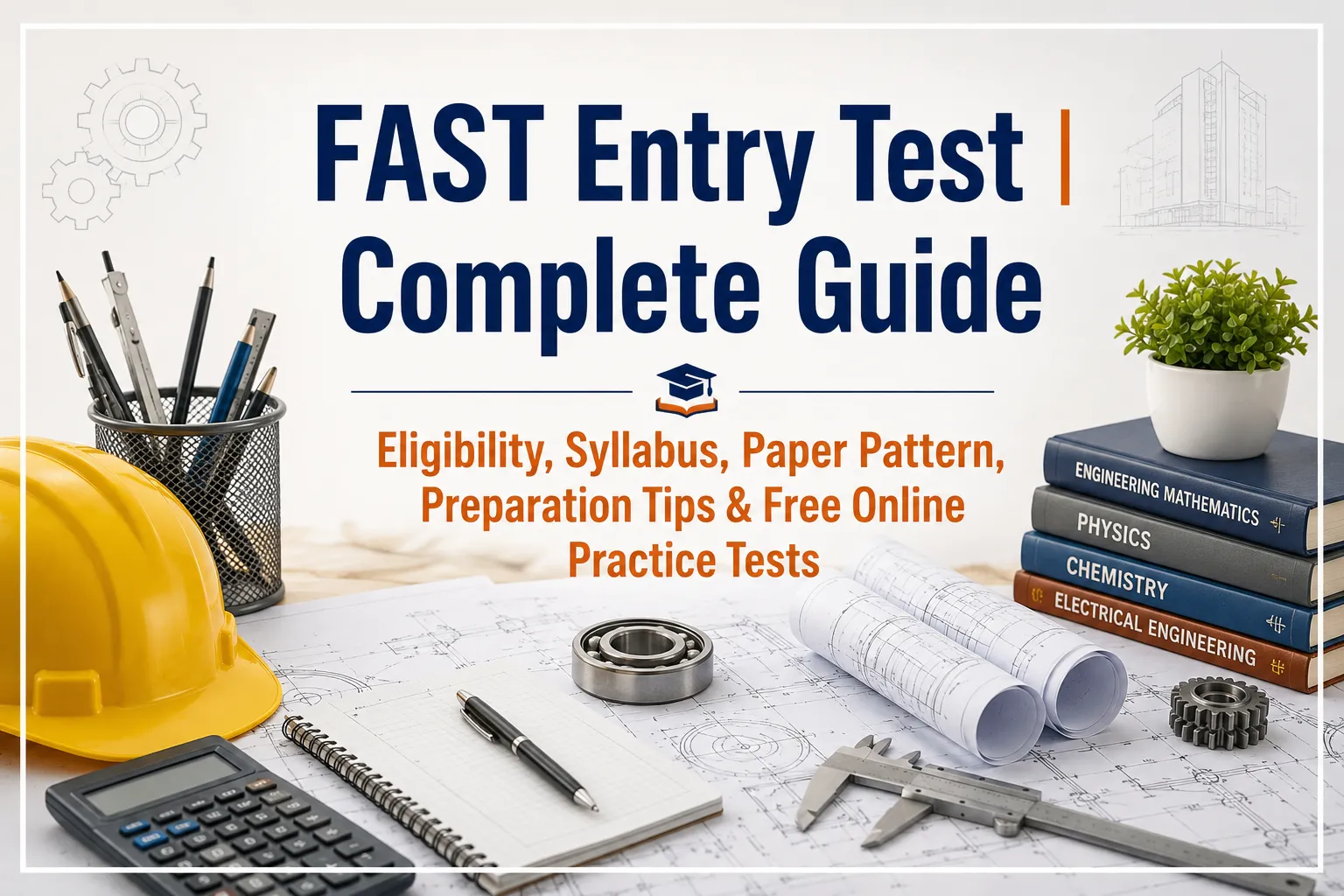
Eligibility, Syllabus, Paper Pattern, Preparation Tips & Free Online Practice Tests
FAST - National University of Computer and Emerging Sciences (NUCES) is one of Pakistan's premier institutions for computer science, engineering, business, and emerging technology programs. Every year, thousands of students aspire to join FAST for its exceptional academic reputation, industry connections, and outstanding career prospects. The FAST Entry Test serves as the gateway to this prestigious institution, making it essential for candidates to understand its nuances thoroughly.
If you are planning to pursue a degree in Computer Science, Software Engineering, Artificial Intelligence, Data Science, Cyber Security, Electrical Engineering, Business Administration, or related fields, acing the FAST entry test is your first and most critical step.
This comprehensive guide answers the most common questions asked by FAST aspirants:
-
What is the FAST entry test?
-
Who conducts it?
-
What is the eligibility criteria?
-
What is the test pattern and syllabus?
-
How is the merit calculated?
-
How can I prepare effectively?
-
Where can I practice FAST MCQs online for free?
Students who want to begin their preparation immediately can start with FAST Entry Test Practice , where hundreds of free chapter-wise quizzes are available to strengthen concepts and improve exam performance.
What is the FAST Entry Test?
The FAST Entry Test is a university-specific, computer-based admission test conducted annually by FAST-NUCES. It evaluates a candidate's conceptual understanding, analytical reasoning, mathematical skills, and English language proficiency. The test is designed to assess readiness for FAST's rigorous academic programs.
The university is particularly known for its strong emphasis on mathematics and analytical skills, as these form the foundation for success in computing and engineering disciplines. A good score on the FAST entry test is crucial, as it carries a significant weight of 50% in the merit calculation for computing and business programs.
Why is the FAST Entry Test Important?
FAST-NUCES, with its campuses in Islamabad, Lahore, Karachi, Peshawar, and Multan, receives thousands of applications for a limited number of seats each year. The FAST Entry Test provides a standardized, merit-based mechanism to evaluate candidates from diverse educational backgrounds fairly.
-
It allows the university to assess a candidate's aptitude beyond their academic transcripts.
-
It compares students from different boards (FSc, A-Levels, etc.) on an equal footing.
-
It creates a transparent merit list, ensuring that the most capable students gain admission.
For students, performing well in this test can be the defining factor that secures admission to their desired program, especially highly competitive fields like Computer Science and Artificial Intelligence.
FAST Entry Test Pattern
The pattern for the FAST entry test is section-based and individually timed. Understanding this structure is key to effective preparation.
Test Format for BS (CS/Engineering)
The test is computer-based and consists of 120 MCQs to be completed in 120 minutes. Each section is timed independently, and time saved in one section is not transferred to the next.
-
Advanced Mathematics: 50 MCQs in 50 minutes
-
Basic Mathematics: 20 MCQs in 20 minutes
-
Analytical Skills & IQ: 20 MCQs in 20 minutes
-
English: 30 MCQs in 30 minutes
-
Total: 120 MCQs in 120 minutes
-
Marking: +1 for correct; -0.25 for wrong in Math/IQ sections
Test Format for BBA & BS (Business Programs)
The pattern is different for business programs, with a higher focus on Basic Math and Analytical Skills.
-
Basic Math: 50% weightage
-
Analytical Skills & IQ: 25% weightage
-
English: 10% weightage
-
Essay Writing: 15% weightage
FAST Entry Test Syllabus
The syllabus for the FAST entry test is based on the FSc (Intermediate) curriculum, with a significant emphasis on advanced mathematics. Practice MCQs for each section are available for free on the FAST Entry Test platform .
Advanced Mathematics (50 MCQs)
This is the most heavily weighted section and covers FSc Part I & II Mathematics. Start your preparation with Advanced Maths Practice Tests .
The Advanced Mathematics syllabus includes:
-
Analytical Geometry in Three Dimensions
-
Coordinate Geometry
-
Differential Equations
-
Differentiation
-
Functions and Limits
-
Integration
-
Mathematical Induction and Binomial Theorem
-
Matrices and Determinants
-
Permutation Combination and Probability
Basic Mathematics (20 MCQs)
This section tests foundational mathematical concepts. Start your preparation with Basic Maths Practice Tests .
The Basic Mathematics syllabus includes:
-
Number Systems
-
Partial Fractions
-
Quadratic Equations
-
Sequences and Series
-
Sets Functions and Groups
-
Trigonometry
-
Vectors
Analytical Skills & IQ (20 MCQs)
This section assesses logical reasoning and critical thinking ability. Start your preparation with Analytical Skills Practice Tests .
The Analytical Skills syllabus includes:
-
Blood Relations
-
Cause and Effect
-
Coding and Decoding
-
Course of Action
-
Decision Making
-
Direction and Distance
-
Logical Deduction
-
Non-Verbal Reasoning
-
Ranking and Sequencing
-
Seating Arrangement
-
Series and Patterns
-
Statements and Arguments
-
Statements and Assumptions
-
Statements and Conclusions
-
Syllogism
English (30 MCQs)
This section follows an SAT-style pattern and tests grammar, vocabulary, and comprehension. Start your preparation with English Practice Tests .
The English syllabus includes:
-
Antonyms
-
Comprehension
-
Parts of Speech
-
Subject Verb Agreement
-
Synonyms
-
Tenses
-
Word Usage
FAST Eligibility Criteria
Eligibility criteria vary slightly depending on the chosen program.
For BS (Computing Programs) & BBA / BS (Accounting and Finance / Business Analytics / Financial Technology)
-
Minimum 50% marks in F.Sc / HSSC / A-Levels or equivalent.
-
Minimum 60% marks in Matric / SSC / O-Levels or equivalent.
For BS (Engineering Programs)
-
Minimum 60% marks in F.Sc / HSSC / A-Levels or equivalent (with required science subjects).
-
Minimum 60% marks in Matric / SSC / O-Levels or equivalent.
FAST Merit Calculation Formula
Your final merit for FAST admission is calculated using a precise formula. It combines your academic records and the FAST entry test score.
For BS (Computing Programs) & Business Programs
-
SSC / Matric Marks: 10%
-
FSc / HSSC Marks: 40%
-
FAST Entry Test Marks: 50%
For BS (Engineering Programs)
-
SSC / Matric Marks: 17%
-
FSc / HSSC Marks: 50%
-
FAST Entry Test Marks: 33%
This weightage clearly shows that a strong performance in the FAST entry test is paramount for admission to computing programs. Focused preparation using the free FAST practice tests available is crucial for a high aggregate score.
FAST Entry Test Preparation Tips
1. Understand the Section-Based Timing
The most critical aspect of the FAST test is its section-based timing. Each section has a fixed duration, and you cannot move back to a previous section. Practice using a timer for each section to build the right rhythm.
2. Master Advanced Mathematics
With 50 MCQs, Advanced Mathematics is the highest-scoring section. Focus on FSc Part I & II calculus, trigonometry, and algebra. Practice extensively from chapter-wise quizzes available on the Advanced Maths page.
3. Hone Your Analytical Skills
The IQ section is unique to FAST and requires dedicated practice. Familiarize yourself with the question types like series, patterns, and logical deduction. The chapter-wise quizzes on the Analytical Skills page are an excellent resource.
4. Practice with Past Papers and Mock Tests
Solving past papers and taking full-length mock tests under exam-like conditions is the most effective way to prepare. It helps you manage time, understand the question difficulty, and identify your weak areas.
5. Manage Negative Marking
There is a negative marking of -0.25 per wrong answer in the math and IQ sections. Do not guess blindly. Learn to eliminate obviously wrong options to make an educated guess.
6. Prepare Strategically
Don't study everything at once. Segment your plan based on the test format. Focus your time and energy on high-yield sections like Advanced Maths.
Recommended Preparation Books
A comprehensive preparation book can provide structure and valuable practice material. Some recommended resources include:
-
FAST BS (CS & Engineering) Entry Test Guide 2026 – Covers the complete syllabus with MCQs, past papers, and practice tests.
-
KIPS FAST Entry Test Prep Books – Known for their practice tests and MCQs covering FAST's specific pattern.
Final Words
Cracking the FAST entry test is a challenging but achievable goal. It requires a clear understanding of the unique test pattern, a strategic study plan, and consistent practice. Start your preparation today by exploring the subject-wise and chapter-wise practice quizzes available on Pak Admissions . With the right approach and dedication, you can secure your place at one of Pakistan's leading technology universities.
Good luck with your FAST Entry Test 2026 preparation!