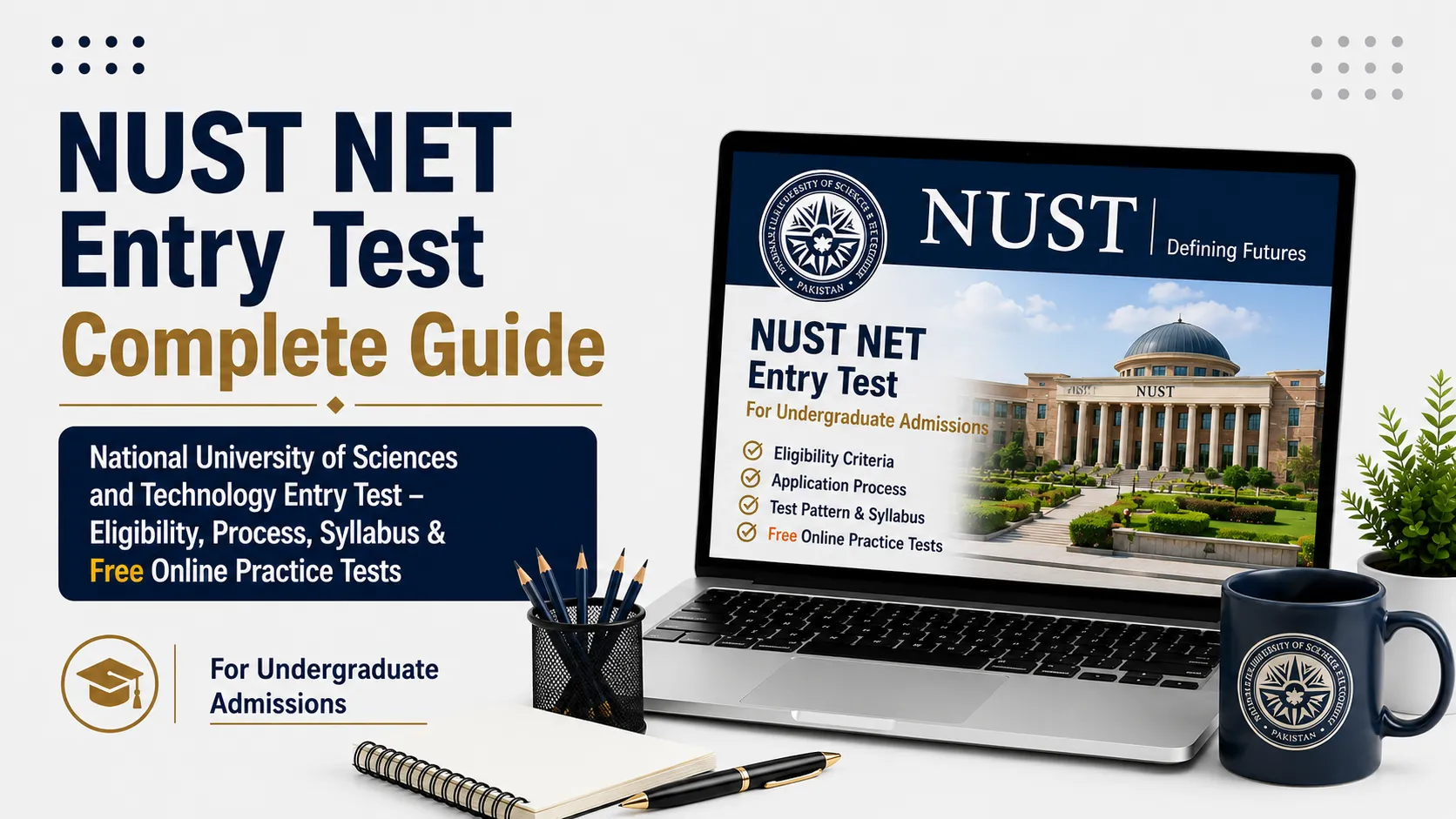
National University of Sciences and Technology Entry Test – Eligibility, Process, Syllabus & Free Online Practice Tests
The National University of Sciences and Technology (NUST) is one of Pakistan's most prestigious institutions, consistently ranked among the top universities in the country. Every year, thousands of students aspire to join NUST for its world-class faculty, state-of-the-art facilities, and exceptional career opportunities. The NUST Entry Test (NET) serves as the primary gateway for undergraduate admissions, making it essential for candidates to understand its nuances thoroughly.
If you are planning to apply for undergraduate admissions at NUST, this comprehensive guide covers everything you need to know:
-
What is the NUST Entry Test (NET) and which programs accept it?
-
What are the eligibility criteria?
-
How to apply for NET?
-
What is the test pattern, number of MCQs, and time allowed?
-
What is the complete syllabus?
-
How can I practice NUST NET MCQs online for free?
Students who want to begin their preparation immediately can start with NUST NET Practice Test , where hundreds of free chapter-wise quizzes are available to strengthen concepts and improve exam performance.
About NUST
The National University of Sciences and Technology (NUST) is a public research university with its main campus in Islamabad. Established in 1991, NUST has grown to become one of Pakistan's leading institutions for engineering, computing, business, and natural sciences.
NUST offers a wide range of undergraduate programs through its various schools and colleges:
-
School of Electrical Engineering and Computer Science (SEECS)
-
College of Electrical and Mechanical Engineering (CEME)
-
School of Mechanical and Manufacturing Engineering (SMME)
-
School of Civil and Environmental Engineering (SCEE)
-
School of Chemical and Materials Engineering (SCME)
-
School of Natural Sciences (SNS)
-
NUST Business School (NBS)
-
School of Art, Design and Architecture (SADA)
Admission to all undergraduate programs is highly competitive and is granted solely on the basis of merit, with the NUST Entry Test (NET) carrying the highest weightage.
What is NET?
The NUST Entry Test (NET) is a standardized entrance examination conducted by NUST for admission to its undergraduate programs. The test is designed to assess a candidate's knowledge and understanding of core subjects at the intermediate (HSSC) level, along with analytical and reasoning abilities.
Key Features of NET
-
Multiple Attempts: Candidates can appear in the entry test more than once, and the best score is considered for admission. However, only one attempt is allowed per discipline in any single series.
-
Test Validity: The result of NET remains valid only for the current admission cycle.
-
Test Locations: NET is conducted at four locations: Islamabad (NUST Campus, computer-based), Karachi (paper-based), Quetta (computer-based), and Gilgit (paper-based).
-
Test Format: At Islamabad and Quetta, the test is computer-based; in Karachi and Gilgit, it is paper-based.
-
No Negative Marking: There is no negative marking in any section of the test.
Programs Accepting NET
NET is accepted for a wide range of undergraduate programs across various disciplines. The test is categorized into different streams based on the academic background of the candidate and the program applied for.
Engineering and Computing Programs
-
Engineering Programs: Chemical Engineering, Civil Engineering, Computer Engineering, Electrical Engineering, Mechanical Engineering, Aerospace Engineering, Avionics Engineering, and others
-
Computing Programs: BS Computer Science, BS Data Science, BS Artificial Intelligence, BS Bioinformatics
-
Other Programs: BS Mathematics, BS Physics, BS Chemistry, BS Food Science and Technology
Candidates with Pre-Engineering (Mathematics, Physics, Chemistry), Pre-Medical (with additional Math or without), or ICS (Mathematics, Physics, Computer Science) backgrounds can apply for these programs.
Applied Sciences Programs
-
BS Biotechnology
-
BS Environmental Science
-
BS Agriculture
These programs are primarily for candidates with a Pre-Medical background.
Business Studies and Social Sciences
-
BBA
-
BS Public Administration
-
BS Mass Communication
-
BS Economics
-
BS Psychology
-
BS Accounting and Finance
-
LLB
-
BS Tourism and Hospitality Management
-
BS Liberal Arts and Humanities
These programs are open to candidates with any subject combination in HSSC or equivalent.
Architecture and Design
-
B Architecture
-
B Industrial Design
These programs require Mathematics and Physics as mandatory subjects.
Eligibility Criteria
Eligibility criteria for NUST admissions are clearly defined for different qualification backgrounds. Candidates must meet the minimum requirements to be considered for admission.
General Eligibility
-
Minimum 60% aggregate marks each in SSC and HSSC (or equivalent as per IBCC equivalence).
-
For FA/FSc Stream: Candidates can apply on the basis of FA/FSc Part-I, but confirmation of admission is subject to provision of the final certificate with required marks.
-
For O/A Level Candidates: Must have equivalence certificates duly obtained from IBCC, Pakistan, with minimum 60% marks.
-
For Foreign Qualifications: American High School Diploma, International Baccalaureate (IB), or other equivalent qualifications must have IBCC equivalence with minimum 60% marks.
Program-Specific Eligibility
Engineering Programs
-
SSC with Science group AND HSSC Pre-Engineering (Math, Physics, Chemistry) OR HSSC Computer Science (Math, Physics, Computer Science) OR HSSC Pre-Medical with Additional Math
BS Computer Science, BS Data Science, BS Artificial Intelligence, BS Bioinformatics
-
SSC with Science group AND HSSC Pre-Engineering OR HSSC Computer Science OR HSSC Pre-Medical (with Math as mandatory subject for Bioinformatics)
BS Biotechnology, BS Environmental Science, BS Agriculture
-
SSC with Science group AND HSSC Pre-Medical (Biology, Physics, Chemistry)
BBA, BS Economics, BS Mass Communication, BS Public Administration, BS Psychology, BS Tourism and Hospitality Management, BS Liberal Arts and Humanities
-
SSC AND HSSC with any combination
LLB
-
SSC AND HSSC with any combination AND valid HEC Law Admission Test (LAT) score with minimum 50% marks
Note: Foreign nationals (Non-Pakistani) cannot apply for Aerospace and Avionics Engineering programs offered at the CAE campus Risalpur.
NUST NET Application Process
The application process for NET is conducted entirely online through the NUST admissions portal.
Step-by-Step Application Guide
-
Visit the Official Admission Portal: ugadmissions.nust.edu.pk
-
Create an Account: Register with your email address and create a password. Fill in your personal and academic details accurately.
-
Select the Test and Program: Choose the appropriate NET stream based on your academic background and desired program. Select your program preferences carefully.
-
Enter Academic Details: Enter marks according to original academic documents. O/A Level candidates should enter marks according to IBCC equivalence certificates.
-
Upload Required Documents:
-
Recent passport-size photograph
-
CNIC / Form B / NICOP (mandatory)
-
-
Pay the Application Fee:
-
For NUST Entry Test (per exam): Rs. 5,000/- or USD 40/-
-
For ACT/SAT based National seat: Rs. 5,000/- or USD 40/-
-
For ACT/SAT based International seat: Rs. 10,000/- or USD 80/-
-
For Foreign Nationals NET (per exam): Rs. 10,000/- or USD 80/-
-
The fee is non-refundable and non-transferable.
-
-
Submit Application: Review all information before final submission. Submit the online application form.
-
Download Admit Card: After successful submission and payment, download your admit card. For computer-based NET, choose your preferred test date and session from the available schedule.
NET Test Series Schedule
NUST conducts 4 test series per year. Candidates can appear in multiple series, and the best score is used for merit calculation.
-
Series 1: Online Registration (05 Oct – 25 Nov 2025), Test Schedule (22 Nov – 10 Dec 2025)
-
Series 2: Online Registration (14 Dec 2025 – 01 Feb 2026), Test Schedule (31 Jan – 15 Feb 2026)
-
Series 3: Online Registration (22 Feb – 05 Apr 2026), Test Schedule (04 Apr – 02 May 2026)
-
Series 4: Online Registration (26 Apr – 18 Jun 2026), Test Schedule (13 Jun 2026 onwards)
Dates are tentative and subject to change. Always verify on the official NUST website.
Test Venues
-
Islamabad: H-12 Campus (Computer-Based)
-
Karachi: DHA City (Paper-Based)
-
Quetta: NBC (Computer-Based)
-
Gilgit: APS Jutial (Paper-Based)
Test Timings
-
Morning: 0900 – 1200 hrs
-
Afternoon: 1400 – 1700 hrs
NUST NET Test Pattern
The NUST Entry Test is a computer-based or paper-based exam consisting of 200 multiple-choice questions (MCQs) to be completed in 180 minutes (3 hours).
Test Pattern Overview
-
Total MCQs: 200
-
Total Time: 180 minutes (3 hours)
-
Test Mode: Computer-Based (Islamabad, Quetta) / Paper-Based (Karachi, Gilgit)
-
Negative Marking: None
-
Total Marks: 200
-
Calculator: Not allowed
Section-Wise Breakdown for NET-Engineering
-
Mathematics: 100 MCQs (50% weightage)
-
Physics: 60 MCQs (30% weightage)
-
English: 40 MCQs (20% weightage)
-
Total: 200 MCQs (100%)
Other NET Streams
-
NET-Applied Sciences: Biology (50%), Chemistry (30%), English (20%)
-
NET-Business Studies & Social Sciences: Quantitative Mathematics (50%), English (50%)
-
NET-Architecture: Design Aptitude (50%), Mathematics (30%), English (20%)
-
NET-Natural Sciences: Mathematics (50%), English (50%)
NUST NET Syllabus
The NET syllabus is based on the HSSC (FSc / Intermediate) curriculum. The test is compiled from textbooks prescribed for HSSC courses. Below is the chapter-wise breakdown for each subject for the NET-Engineering stream.
Start your preparation with NUST NET Practice Test .
Mathematics (100 MCQs) – 50% Weightage
The Mathematics section is the most heavily weighted and covers a wide range of topics from intermediate level. Start your preparation with NUST NET Maths Practice Tests .
The Mathematics syllabus includes:
-
Number Systems — Real numbers, complex numbers, algebraic operations, Argand diagram
-
Complex Numbers — Complex numbers, operations, Argand diagram
-
Matrices — Types of matrices, operations, determinants, inverse, system of linear equations
-
Determinants — Determinants, properties, applications
-
Quadratic Equations — Solution methods, nature of roots, sum and product of roots, equations in radicals
-
Sequences and Series — Arithmetic Progression (AP), Geometric Progression (GP), Harmonic Progression (HP) — nth term, sum formulas, means
-
Permutations — Counting principles, factorial notation, nPr, nCr
-
Combinatorics and Probability — Counting principles, probability theorems
-
Mathematical Induction — Principle of mathematical induction
-
Binomial Theorem — Binomial expansion, general term, middle term
-
Trigonometry — Trigonometric functions and identities, equations, inverse functions, solution of triangles, area of triangle
-
Functions and Graphs — Domain and range, types of functions, composition, inverse, graphical transformations
-
Differential Calculus — Limits, continuity, differentiation rules, derivatives of trigonometric/logarithmic/exponential functions, maxima and minima
-
Integral Calculus — Indefinite and definite integrals, integration techniques, areas and volumes
-
Analytic Geometry — Straight lines, circles, parabola, ellipse, hyperbola — equations and properties
-
Vectors — 2D and 3D vectors, addition, scalar and vector product, geometric applications
Physics (60 MCQs) – 30% Weightage
The Physics section assesses understanding of core physical concepts. Start your preparation with NUST NET Physics Practice Tests .
The Physics syllabus includes:
-
Measurements and Vectors — SI Units, errors, physical quantities, vectors, equilibrium
-
Kinematics — Motion in one and two dimensions, equations of motion
-
Dynamics — Newton's laws of motion, force, momentum, friction
-
Work Energy and Power — Work, power, energy, conservation of energy
-
Electrostatics — Coulomb's law, electric fields, electric potential, capacitance
-
Current Electricity — Ohm's law, circuits, resistivity, Kirchhoff's laws
-
Electromagnetism — Magnetic fields, forces on moving charges, electromagnetic induction
-
Optics — Geometrical optics, reflection, refraction, lenses, optical instruments
-
Thermodynamics — Laws of thermodynamics, heat engines, entropy
-
Modern Physics — Relativity, quantum theory, atomic physics, nuclear physics
English (40 MCQs) – 20% Weightage
The English section follows an SAT-style pattern and tests grammar, vocabulary, and comprehension skills. Start your preparation with NUST NET English Practice Tests .
The English syllabus includes:
-
Vocabulary — Synonyms, antonyms, word meanings
-
Grammar and Sentence Structure — Parts of speech, tenses, subject-verb agreement, sentence correction
-
Sentence Completion — Fill in the blanks, vocabulary in context
-
Reading Comprehension — Passage analysis, inference, main idea, supporting details
NUST Merit Calculation
Merit for admission to NUST is generated based on the following formula for candidates applying on NET basis:
-
NUST Entry Test (NET): 75%
-
SSC / O Level / Equivalent: 10%
-
HSSC (Part-1) / HSSC / A Level / Equivalent / DAE: 15%
For O/A Level candidates who are in their final year (A Level), 25% weightage is assigned to their O Level equivalence marks.
Merit lists for NET and ACT/SAT-based National and International seats are generated tentatively by the last week of July.
NUST Preparation Tips
-
Understand the Test Pattern: The NET Engineering stream consists of 200 MCQs with no negative marking. Mathematics carries the highest weightage (50%), followed by Physics (30%) and English (20%). Focus your preparation accordingly.
-
Know the Syllabus Thoroughly: Familiarize yourself with the complete chapter-wise syllabus for Mathematics, Physics, and English. Use the official syllabus as a checklist to ensure you cover every topic.
-
Practice Chapter by Chapter: Complete one chapter at a time and immediately attempt the relevant chapter-wise quiz. The free quizzes on Pak Admissions are designed specifically for this purpose.
-
Focus on High-Yield Topics:
-
Mathematics: Calculus, Trigonometry, Algebra, and Vectors are heavily tested.
-
Physics: Mechanics, Electricity, Magnetism, and Thermodynamics form the core.
-
English: Reading Comprehension, Vocabulary, and Grammar are key areas.
-
-
Take Full-Length Mock Tests: Take full-length mock tests under timed conditions (3 hours) to improve your time management skills and build stamina for the actual exam.
-
Analyze Your Mistakes: Review every mistake. Understanding why you got a question wrong is how you truly learn and avoid repeating the same errors.
-
Start Early: Begin your preparation well in advance. Don't wait until the last month. Starting early gives you the best results.
-
Take Advantage of Multiple Attempts: You can appear in multiple NET series, and your best score is considered for admission. Use earlier attempts as practice to improve your score.
Frequently Asked Questions (FAQs)
-
How many times can I appear in NET?
-
You can appear in the entry test more than once. The best score is considered for admission. However, only one attempt is allowed per discipline in any single series.
-
-
Is there negative marking in NET?
-
No, there is no negative marking in any section of the NUST Entry Test.
-
-
What is the test duration for NET?
-
The test duration is 180 minutes (3 hours).
-
-
How many MCQs are in the NET Engineering test?
-
The NET Engineering test consists of 200 MCQs: Mathematics (100), Physics (60), and English (40).
-
-
What is the minimum eligibility requirement for NUST?
-
Candidates must have minimum 60% aggregate marks each in SSC and HSSC (or equivalent as per IBCC equivalence).
-
-
Can Pre-Medical students apply for Engineering programs?
-
Yes, Pre-Medical students can apply for Engineering programs. However, they must appear in NET-Engineering and are required to clear a condensed Mathematics course of 8 weeks offered by NUST prior to admission.
-
-
Can I apply on the basis of ACT or SAT?
-
Yes, admission can be sought on the basis of NUST Entry Test (NET) or American College Test (ACT) / Scholastic Aptitude Test (SAT) for which limited seats are available.
-
-
How can I practice for NUST NET?
-
You can practice for free on Pak Admissions . The platform offers over 1,254 MCQs across 126 quizzes covering all subjects.
-
Final Words
Securing admission to NUST is a significant achievement that opens the door to a promising career in engineering, computing, or business. With its rigorous academic standards, modern campus, and strong industry connections, NUST offers an unparalleled educational experience. Start your preparation today by exploring the chapter-wise practice quizzes available on Pak Admissions .
Good luck with your NUST NET preparation!