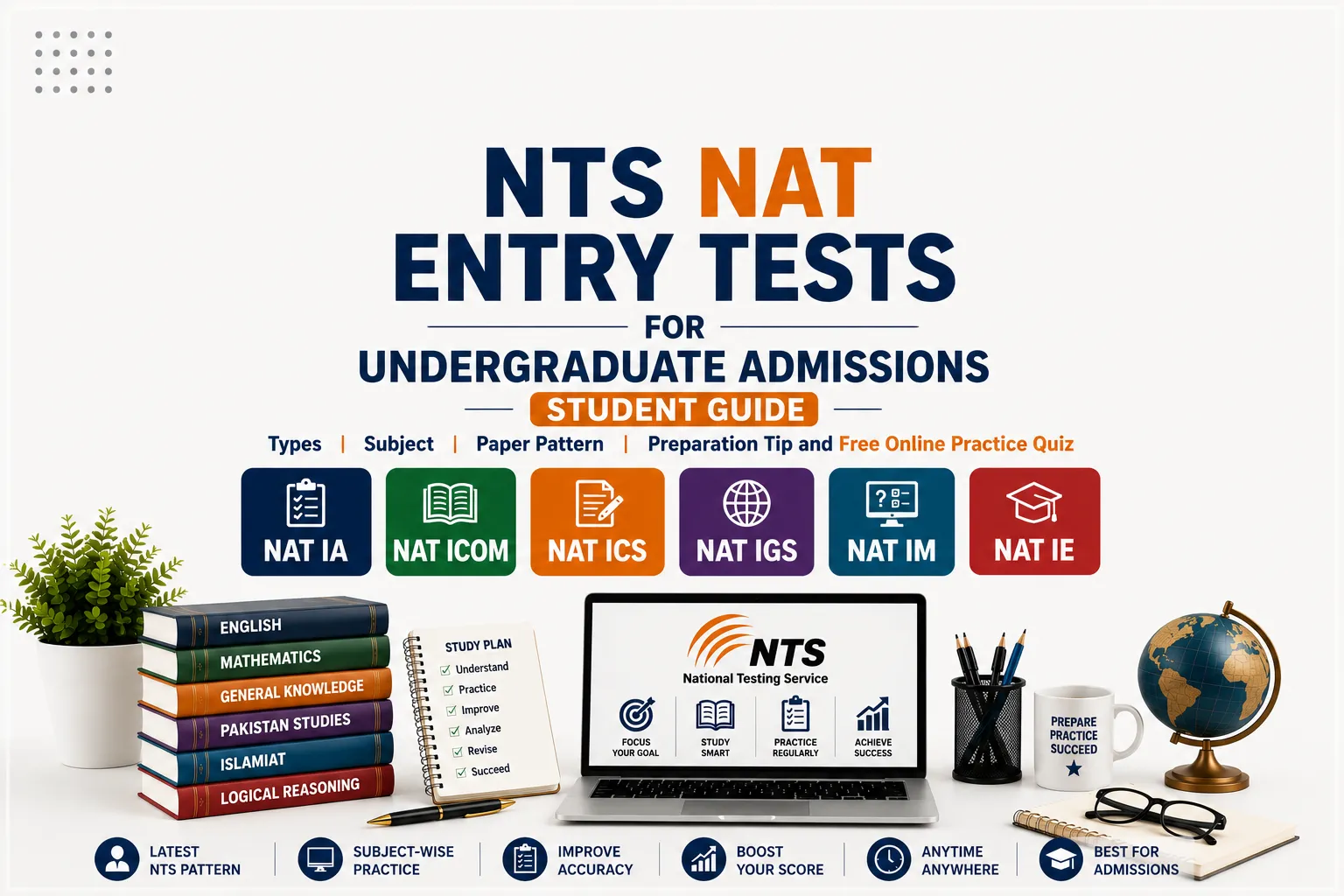
The National Aptitude Test (NAT) is a standardized entrance examination conducted by the National Testing Service (NTS) of Pakistan. It serves as a gateway for students seeking admission to undergraduate (4-year Bachelor's) programs at universities and degree-awarding institutes (DAIs) recognized by the Higher Education Commission (HEC).
NAT is divided into two main categories: NAT-I for candidates who have completed 12 years of education (Intermediate) and NAT-II for those with 14 years of education (Bachelor's).
If you are planning to apply for undergraduate admissions through NTS, this comprehensive guide covers everything you need to know about the different types of NTS NAT tests:
-
What are the different types of NTS NAT tests?
-
Which test should I take based on my academic background?
-
Which programs accept each test type?
-
Which universities accept NTS NAT?
-
What are the eligibility criteria?
-
How to apply for NTS NAT?
-
What is the test pattern, number of MCQs, and time allowed?
-
What subjects are included in each test?
Students who want to begin their preparation immediately can start with NTS Free Quiz , where hundreds of free chapter-wise quizzes are available to strengthen concepts and improve exam performance.
What is NTS NAT?
NTS offers six categories of NAT-I tests, each designed for a specific academic background. The six NAT-I categories are:
-
NAT-IA: Arts & Humanities Group
-
NAT-IE: Pre-Engineering Group
-
NAT-IM: Pre-Medical Group
-
NAT-ICS: Computer Science Group
-
NAT-ICOM: Commerce Group
-
NAT-IGS: General Science Group
Each test is specifically designed for candidates from the respective academic background. The tests include subject-related questions along with aptitude-based sections.
The test is valid for one year from the date of result declaration. Candidates can appear for the test multiple times and use their best score for admissions.
NTS NAT Test Types and Subjects
1. NAT-IA (Arts & Humanities Group)
The NAT-IA test is designed for candidates from the Arts & Humanities background. It consists of 970 MCQs across 97 quizzes.
Subjects included:
-
English – Grammar, vocabulary, comprehension, and language skills
-
General Knowledge – Current affairs, history, geography, science, and technology
-
Islamiat – Basic Islamic knowledge, Quran, Hadith, and Seerah
-
Logical and Analytical Thinking – Reasoning, problem-solving, and analytical skills
-
Pak Studies – Pakistan's history, culture, geography, and politics
-
Quantitative Reasoning – Basic arithmetic, algebra, and geometry
Programs applicable: BA / BS in Arts & Humanities, Social Sciences, Psychology, Sociology, Political Science, International Relations, Economics, Business Administration, LLB, and other non-science undergraduate programs.
2. NAT-ICOM (Commerce Group)
The NAT-ICOM test is designed for candidates from the Commerce background. It consists of 890 MCQs across 89 quizzes.
Subjects included:
-
Accounting – Basic accounting principles, journal entries, ledgers, trial balance, financial statements
-
Commerce – Business organization, trade, banking, entrepreneurship
-
Economics – Demand and supply, market structures, national income, inflation, monetary policy
-
English – Grammar, vocabulary, comprehension, and language skills
-
Logical and Analytical Thinking – Reasoning, problem-solving, and analytical skills
-
Quantitative Reasoning – Basic arithmetic, algebra, and geometry
Programs applicable: BBA, BS Accounting & Finance, BS Economics, BS Commerce, BS Business Administration, BS Management Sciences, BS Banking & Finance, and other commerce-related programs.
3. NAT-ICS (Computer Science Group)
The NAT-ICS test is designed for candidates from the Computer Science background. It consists of 1522 MCQs across 153 quizzes.
Subjects included:
-
Computer Science – Programming fundamentals, data representation, control structures, arrays, strings, functions, operating systems, computer networks, boolean algebra, number systems
-
English – Grammar, vocabulary, comprehension, and language skills
-
Logical and Analytical Thinking – Reasoning, problem-solving, and analytical skills
-
Maths – Algebra, trigonometry, calculus, functions, coordinate geometry
-
Physics – Mechanics, waves, optics, electricity, electromagnetism, thermodynamics
-
Quantitative Reasoning – Basic arithmetic, algebra, and geometry
Programs applicable: BS Computer Science, BS Software Engineering, BS Information Technology, BS Data Science, BS Artificial Intelligence, BS Cyber Security, and other computing-related programs.
4. NAT-IE (Pre-Engineering Group)
The NAT-IE test is designed for candidates from the Pre-Engineering background. It consists of 1724 MCQs across 173 quizzes.
Subjects included:
-
Chemistry – Chemical bonding, equilibrium, electrochemistry, organic chemistry, hydrocarbons
-
English – Grammar, vocabulary, comprehension, and language skills
-
Logical and Analytical Thinking – Reasoning, problem-solving, and analytical skills
-
Maths – Algebra, trigonometry, calculus, functions, coordinate geometry, vectors
-
Physics – Mechanics, waves, optics, electricity, electromagnetism, thermodynamics, modern physics
-
Quantitative Reasoning – Basic arithmetic, algebra, and geometry
Programs applicable: BE / BS in Electrical Engineering, Mechanical Engineering, Civil Engineering, Chemical Engineering, Computer Engineering, Aerospace Engineering, and other engineering and technology-related programs.
5. NAT-IM (Pre-Medical Group)
The NAT-IM test is designed for candidates from the Pre-Medical background. It consists of 1898 MCQs across 190 quizzes.
Subjects included:
-
Biology – Cell structure, bioenergetics, genetics, evolution, biotechnology, ecosystem, human physiology
-
Chemistry – Chemical bonding, equilibrium, electrochemistry, organic chemistry, hydrocarbons
-
English – Grammar, vocabulary, comprehension, and language skills
-
Logical and Analytical Thinking – Reasoning, problem-solving, and analytical skills
-
Physics – Mechanics, waves, optics, electricity, electromagnetism, thermodynamics, modern physics
-
Quantitative Reasoning – Basic arithmetic, algebra, and geometry
Programs applicable: BS Biosciences, BS Biotechnology, BS Microbiology, BS Biochemistry, BS Genetics, BS Zoology, BS Botany, BS Environmental Science, BS Food Science and Technology, BS Public Health, and other health and life science programs.
6. NAT-IGS (General Science Group)
The NAT-IGS test is designed for candidates from the General Science background. It consists of 2119 MCQs across 212 quizzes.
Subjects included:
-
Biology – Cell structure, bioenergetics, genetics, evolution, biotechnology, ecosystem, human physiology
-
Chemistry – Chemical bonding, equilibrium, electrochemistry, organic chemistry, hydrocarbons
-
English – Grammar, vocabulary, comprehension, and language skills
-
General Science – Introduction to science, living organisms, human body systems, chemical reactions, force and motion, electricity and magnetism, environment and ecology
-
Logical and Analytical Thinking – Reasoning, problem-solving, and analytical skills
-
Physics – Mechanics, waves, optics, electricity, electromagnetism, thermodynamics, modern physics
-
Quantitative Reasoning – Basic arithmetic, algebra, and geometry
Programs applicable: BS Computer Sciences, BS Management Sciences, BS Social Sciences, BS English, BS Psychology, BS Media Studies, BS International Relations, BS Economics, and other science and humanities-related programs.
Which Test Should You Take?
Choosing the right NAT test depends on your academic background:
-
If you have completed your Intermediate in Arts & Humanities, take NAT-IA .
-
If you have completed your Intermediate in Commerce, take NAT-ICOM .
-
If you have completed your Intermediate in Computer Science, take NAT-ICS .
-
If you have completed your Intermediate in Pre-Engineering, take NAT-IE .
-
If you have completed your Intermediate in Pre-Medical, take NAT-IM .
-
If you have completed your Intermediate in General Science, take NAT-IGS .
Universities Accepting NTS NAT
NAT is accepted by numerous universities and degree-awarding institutes (DAIs) across Pakistan that are associated with NTS. Some of the well-known institutions include:
-
Quaid-i-Azam University (QAU), Islamabad
-
COMSATS University, Islamabad – All Campuses
-
FAST - National University of Computer & Emerging Sciences (NUCES) – All Campuses
-
Institute of Space Technology (IST), Islamabad
-
National University of Sciences and Technology (NUST) – selected programs
-
Air University, Islamabad
-
Bahria University, Islamabad
-
International Islamic University, Islamabad
-
Government College University (GCU), Faisalabad
-
Kinnaird College for Women, Lahore
-
National Textile University, Faisalabad
-
University of Gujrat
-
University of Peshawar
-
University of Balochistan, Quetta
-
Balochistan University of Information Technology & Management Sciences (BUITMS), Quetta
-
Gomal University, D.I. Khan
-
Fatima Jinnah Women University, Rawalpindi
-
GIFT University, Gujranwala
-
HITEC University, Taxila
-
Institute of Management Sciences, Peshawar
-
Institute of Southern Punjab, Multan
-
NAMAL University, Mianwali
-
National Defense University (NDU), Islamabad
-
Riphah International University, Islamabad
-
Sarhad University of Science & Information Technology, Peshawar
-
The Superior College, Lahore
-
University of Management & Technology (UMT), Lahore
-
University of South Asia
-
University of Science & Technology, Bannu
-
CECOS University, Peshawar
-
Federal Urdu University of Arts, Science & Technology
-
Kohat University of Science and Technology, Kohat
-
And many other public and private sector universities
Note: This is not an exhaustive list. Candidates are advised to check the official admission advertisement of their desired university to confirm which NAT test is accepted for their chosen program.
NTS NAT Eligibility Criteria
The eligibility criteria for NTS NAT are clearly defined by NTS:
Educational Requirements
-
12 years of education (Intermediate / HSSC) in the relevant group
-
Candidates with A-Level or equivalent qualifications must have IBCC equivalence certificate
-
The test must match the candidate's academic background
Age Requirements
-
No specific age limit is prescribed by NTS
-
Candidates must meet the age requirements of the university they are applying to
Domicile Requirements
-
Candidates from all provinces of Pakistan can apply
-
Some universities may have specific domicile requirements – check the university's admission policy
Test Validity
-
The NAT score is valid for one year from the date of result declaration
Other Requirements
-
Candidates must have a valid CNIC/B-Form and a recent passport-size photograph
-
Candidates must register online through the NTS Candidate Portal
NTS NAT Application Process
The application process for NTS NAT is conducted online through the NTS Candidate Portal.
Step-by-Step Application Guide
-
Visit the Official NTS Website: www.nts.org.pk
-
Create an Account: Click on the NTS Candidate Portal. Register with your email address and create a password. Complete your personal profile.
-
Select the Test: Choose the appropriate NAT test based on your academic background from the list of available tests. The test fee is typically around PKR 840 + service charges.
-
Fill in the Application Form: Enter your personal details, academic information, and CNIC/B-Form number. Upload a recent passport-size photograph with a clear front face.
-
Pay the Application Fee: Download the system-generated challan or deposit slip. Deposit the fee at any online branch of the designated bank. Keep the original NTS copy of the deposit slip.
-
Submit Application: Review all information before final submission. Submit the online application form. For some tests, send the duly filled application form and original deposit slip by post or courier.
-
Download Roll Number Slip: After successful submission and payment, download your roll number slip from the portal. Print the slip and bring it to the test center.
Test Schedule
-
NTS NAT tests are conducted once or twice monthly
-
The test is held at multiple centers across Pakistan
-
Candidates can choose their preferred test date and center
Always verify exact dates and procedures on the official NTS website www.nts.org.pk .
NTS NAT Test Pattern Overview
All NTS NAT tests follow a similar pattern. Each test is a paper-based exam consisting of 90 multiple-choice questions (MCQs) to be completed in 120 minutes (2 hours).
Test Pattern Overview
-
Total MCQs: 90
-
Total Time: 120 minutes (2 hours)
-
Test Mode: Paper-Based
-
Negative Marking: None
-
Total Marks: 90 (1 mark per MCQ)
-
Test Validity: 1 year
Section-Wise Breakdown (Common to All Tests)
-
English: 20 MCQs
-
Analytical Reasoning: 20 MCQs
-
Quantitative Reasoning: 20 MCQs
-
Subject Section: 30 MCQs
Subject Section Breakdown by Test Type
-
NAT-IA : General Knowledge, Islamiat, Pak Studies
-
NAT-ICOM : Accounting, Commerce, Economics
-
NAT-ICS : Computer Science, Physics, Mathematics
-
NAT-IE : Physics, Chemistry, Mathematics
-
NAT-IM : Biology, Chemistry, Physics
-
NAT-IGS : General Science
Detailed Section-wise Distribution
English (20 MCQs)
-
Sentence Completion: 5 MCQs
-
Analogy: 3 MCQs
-
Antonym: 4 MCQs
-
Comprehension: 5 MCQs
-
Synonym: 3 MCQs
Analytical Reasoning (20 MCQs)
-
Scenario Based: 12 MCQs
-
Statements Based: 8 MCQs
Quantitative Reasoning (20 MCQs)
-
Arithmetic: 13 MCQs
-
Algebra: 4 MCQs
-
Geometry: 3 MCQs
Subject Section (30 MCQs)
-
Distribution varies by test type as shown above
NTS NAT Merit Calculation
The final merit for NTS NAT-based admissions is determined by universities based on their specific admission policies. Generally, the merit formula includes:
-
NTS NAT Test Score: Significant weightage
-
Intermediate (HSSC) Marks: Weightage as per university policy
-
Matric (SSC) Marks: Weightage as per university policy
Merit Benchmarks:
-
For Public Sector and Renowned Private universities, merit is more than 72%
-
Merit can be as high as 85% as in QAU for Management Sciences programs
-
Students with more than 75 marks have good chances in most universities
-
For IT universities accepting NAT-ICS, merit closes at around 77%
-
FAST accepts all those who have more than 75 marks in NTS to their CS Program
-
Merit in COMSATS for CS Programs is close to 75%
Different universities have different merit criteria. Some universities may give higher weightage to the NTS NAT score, while others may prioritize academic marks.
NTS NAT Preparation Tips
-
Understand the Test Pattern: All NAT tests consist of 90 MCQs from English, Analytical Reasoning, Quantitative Reasoning, and subject-specific sections. Focus on all sections equally.
-
Know the Syllabus Thoroughly: Familiarize yourself with the complete chapter-wise syllabus for your specific test type.
-
Practice Chapter by Chapter: Complete one chapter at a time and immediately attempt the relevant chapter-wise quiz. The free quizzes on Pak Admissions are designed specifically for this purpose.
-
Focus on High-Yield Topics:
-
English: Vocabulary, grammar, comprehension
-
Analytical Reasoning: Blood relations, coding-decoding, syllogism, logical deduction
-
Quantitative Reasoning: Arithmetic, algebra, geometry
-
Subject Section: Focus on your core subjects based on your academic background
-
-
Practice NTS NAT Past Papers: Going through NTS NAT past papers will give you an idea of the type of questions that are asked and the format of the exam.
-
Daily MCQ Practice: Attempt timed 20–30 MCQs daily (mix of verbal, analytical & quantitative).
-
Take Full-Length Mock Tests: Take full-length mock tests under timed conditions (2 hours) to improve your time management skills and build stamina.
-
Analyze Your Mistakes: Review every mistake. Understanding why you got a question wrong is how you truly learn and avoid repeating the same errors.
-
Time Management: The exam consists of 90 MCQs in 120 minutes. Practice time management to ensure you can attempt all questions.
-
Appear Multiple Times: As NTS is conducted frequently, it is advisable to appear in NTS at least 2-3 times to improve your marks. Even if you are a student with 90% marks, it is advised to appear at least twice. It would be the best strategy to appear in NTS in December/January for the first time when you are in FSc Part-II.
-
Use Official NTS Resources: Visit the official NTS website www.nts.org.pk for the latest updates, test schedules, and sample papers.
Frequently Asked Questions (FAQs)
-
What is the difference between NAT-I and NAT-II?
-
NAT-I is for candidates with 12 years of education (Intermediate), while NAT-II is for candidates with 14 years of education (Bachelor's).
-
-
Which test should I take?
-
Choose the test that matches your academic background: NAT-IA for Arts, NAT-ICOM for Commerce, NAT-ICS for Computer Science, NAT-IE for Pre-Engineering, NAT-IM for Pre-Medical, and NAT-IGS for General Science.
-
-
How many MCQs are in the NAT test?
-
All NAT tests consist of 90 MCQs to be completed in 120 minutes.
-
-
Is there negative marking in NAT?
-
No, there is no negative marking in NTS NAT tests.
-
-
How long is the NAT score valid?
-
The NTS NAT score is valid for one year from the date of result declaration.
-
-
Can I take the NAT test multiple times?
-
Yes, you can appear for the NAT test multiple times and use your best score for admissions.
-
-
How can I practice for NTS NAT?
-
You can practice for free on Pak Admissions . The platform offers over 9,000 MCQs across 913 quizzes covering all subjects.
-
-
Which universities accept NTS NAT?
-
NAT is accepted by numerous HEC-recognized universities across Pakistan, including COMSATS University, Quaid-i-Azam University, FAST, Institute of Space Technology, and many others.
-
Final Words
NTS NAT is your gateway to a wide range of undergraduate programs at top universities across Pakistan. With six different test types catering to various academic backgrounds, there is a NAT test for every student. Choose the right test based on your academic background, prepare strategically, and practice consistently to achieve a high score and secure admission to your desired program.
Start your preparation today by exploring the chapter-wise practice quizzes available on Pak Admissions .
Good luck with your NTS NAT preparation!