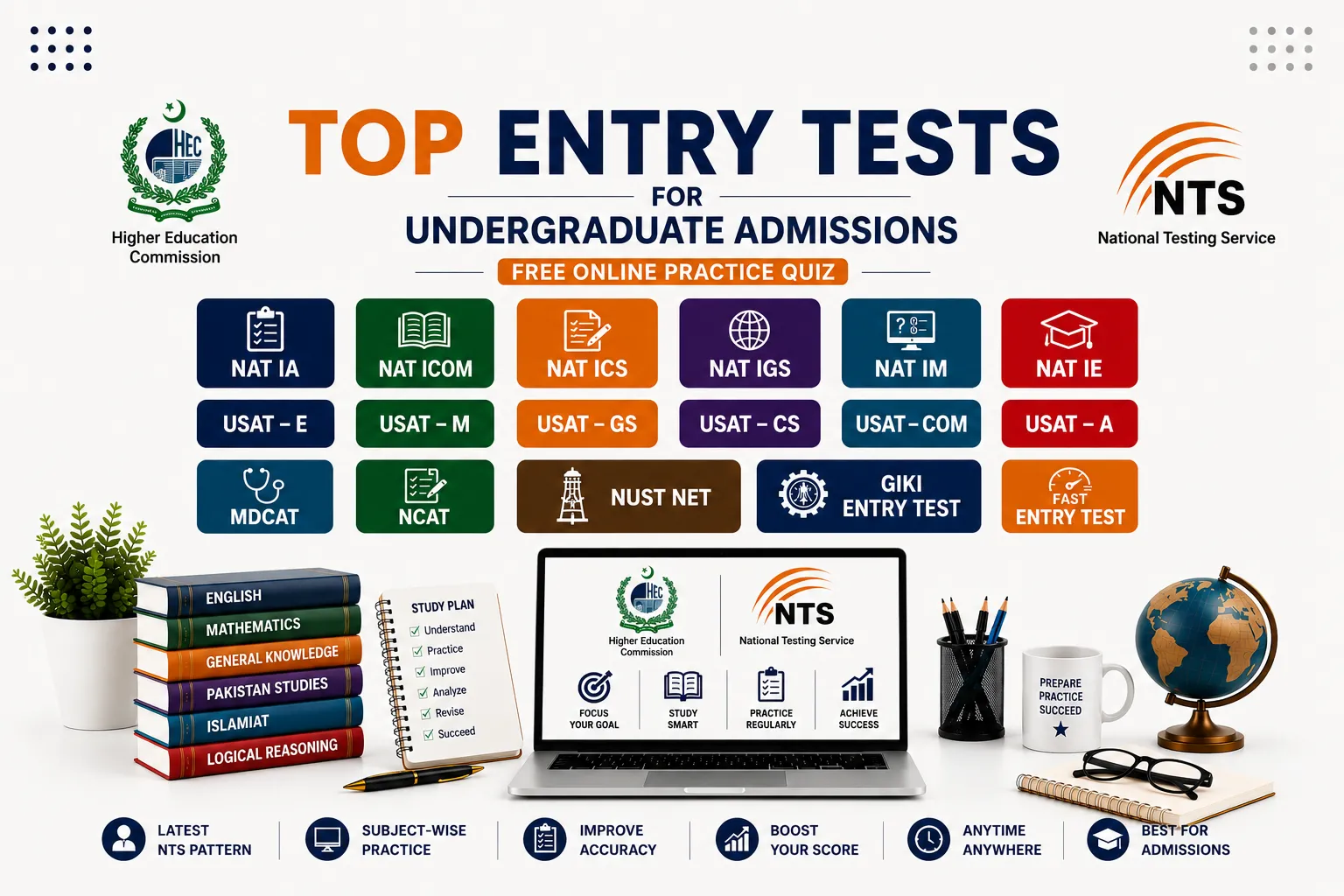
Choosing the right university and program after your intermediate or A-Levels is one of the most important decisions you'll make. In Pakistan, securing a seat in a top-tier institution for engineering, medical, business, or computer science almost always requires clearing a competitive entry test. With so many exams conducted by different bodies, it can be overwhelming to figure out which test you need to take.
This comprehensive guide breaks down the 10 most popular undergraduate entry tests in Pakistan for the 2026 admissions cycle. Whether you're aiming for a career in medicine, engineering, technology, or the arts, we've got you covered. For each test, you'll find essential details like the conducting body, frequency, number of MCQs, time allowed, merit calculation, and a list of applicable programs. Let's dive in.
1. MDCAT (Medical and Dental College Admission Test)
The Medical and Dental College Admission Test (MDCAT) is the standardized entrance test for admission to MBBS and BDS programs in Pakistan. It is conducted by the Pakistan Medical and Dental Council (PMDC) and is a mandatory requirement for all medical and dental colleges across the country.
Conducting Body
Pakistan Medical and Dental Council (PMDC)
UHS / KMU / BUMHS / SZABMU / IBA OR DUHS (Province wise)
Frequency
Once a year (typically in August/September)
Applicable Programs
-
MBBS (Bachelor of Medicine and Bachelor of Surgery)
-
BDS (Bachelor of Dental Surgery)
Test Pattern
-
Total MCQs: 180 (typically)
-
Time Allowed: 3 hours (typically)
-
Test Mode: Paper-Based (conducted simultaneously across Pakistan)
-
Negative Marking: No
Merit Calculation
-
MDCAT Score: 50%
-
Intermediate (FSc) Marks: 40%
-
Matric Marks: 10%
2. ECAT (Engineering College Admission Test)
The Engineering College Admission Test (ECAT) is the entry test for admission to engineering programs, primarily conducted by the University of Engineering and Technology (UET), Lahore and its affiliated colleges. It is a mandatory test for engineering aspirants in Punjab.
Conducting Body
University of Engineering and Technology (UET), Lahore
Frequency
Once a year (typically in June/July)
Applicable Programs
-
Engineering Programs: Electrical, Mechanical, Civil, Chemical, Computer, Software, Mechatronics, Biomedical, Environmental, Industrial, Petroleum, Materials Engineering, and more
-
Computing: Computer Science, Artificial Intelligence, Data Science, Cyber Security, Information Technology
Test Pattern
-
Total MCQs: 100
-
Time Allowed: 100 minutes
-
Test Mode: Computer-Based
-
Negative Marking: Yes (-1 mark for wrong)
Merit Calculation
-
ECAT Score: 30%
-
F.Sc / HSSC Marks: 60%
-
Matric / SSC Marks: 10%
3. NCAT (Nursing Colleges Admission Test)
The Nursing Colleges Admission Test (NCAT) is a standardized entrance examination for admission to 4-year Generic BS Nursing programs in various public and private sector nursing colleges across Pakistan. It is conducted by provincial nursing admission authorities.
Conducting Body
-
Bolan University of Medical & Health Sciences (BUMHS), Quetta (for Balochistan)
-
Directorate of Nursing Sindh (for Sindh)
-
Various other provincial nursing admission authorities and Nursing Colleges
Frequency
Once a year (typically in June/July)
Applicable Programs
-
BS Nursing (4-year Generic program)
More than 18 nursing colleges across Pakistan accept NCAT for BS Nursing admissions, including:
-
CON Shoukat Khanum Hospital
-
CON Shalamar Hospital
-
CON Ittefaq Hospital
-
CON Saeeda Waheed
-
CON University of Lahore
Test Pattern
-
Total MCQs: 100
-
Time Allowed: 120 minutes (2 hours)
-
Test Mode: Paper-Based
-
Negative Marking: None
Merit Calculation
-
NCAT Score: 70% weightage
-
Intermediate Marks: 30% weightage
4. NUST Entry Test (NET)
The NUST Entry Test (NET) is the primary gateway for undergraduate admissions at the National University of Sciences and Technology (NUST) , one of Pakistan's most prestigious institutions. The test is designed to assess a candidate's knowledge and understanding of core subjects at the intermediate (HSSC) level.
Conducting Body
National University of Sciences and Technology (NUST)
Frequency
Conducted 4 times a year (Series 1-4). Candidates can appear in multiple series, and the best score is used for merit calculation.
Applicable Programs
-
Engineering: Chemical, Civil, Computer, Electrical, Mechanical, Aerospace, Avionics Engineering
-
Computing: BS Computer Science, BS Data Science, BS Artificial Intelligence, BS Bioinformatics
-
Other: BS Mathematics, BS Physics, BS Chemistry, BS Food Science and Technology
-
Business Studies and Social Sciences: BBA, BS Economics, BS Mass Communication, BS Psychology, and others
-
Architecture and Design: B Architecture, B Industrial Design
Test Pattern
-
Total MCQs: 200
-
Time Allowed: 180 minutes (3 hours)
-
Test Mode: Computer-Based (Islamabad, Quetta) / Paper-Based (Karachi, Gilgit)
-
Negative Marking: None
Merit Calculation
-
NUST Entry Test (NET): 75%
-
SSC / O Level / Equivalent: 10%
-
HSSC (Part-1) / HSSC / A Level / Equivalent / DAE: 15%
5. GIKI Admission Test
The GIKI Admission Test is the entrance examination for the Ghulam Ishaq Khan Institute of Engineering Sciences and Technology (GIKI) , a top-tier private engineering university known for its residential campus and academic rigor. The test focuses heavily on conceptual understanding of Mathematics, Physics, and English.
Conducting Body
Ghulam Ishaq Khan Institute of Engineering Sciences and Technology (GIKI)
Frequency
Once a year (typically in July)
Applicable Programs
-
Engineering: Chemical, Civil, Computer, Electrical, Mechanical Engineering
-
Computing: BS Artificial Intelligence (AI), BS Computer Science (CS), BS Cyber Security (CyS), BS Data Science (DS), BS Software Engineering (SE)
-
Management Sciences: BS Management Sciences
Test Pattern
-
Total MCQs: 80
-
Time Allowed: 120 minutes (2 hours)
-
Test Mode: Computer-Based (conducted simultaneously at multiple centers across Pakistan)
-
Negative Marking: None
Merit Calculation
-
Admission Test Score: 85% weightage
-
HSSC Part I + SSC/Equivalent: 10% + 5% weightage
-
O-Level (for A-Level candidates): 15% weightage
6. FAST Entry Test (NU Test)
The FAST Entry Test is the admission test for the National University of Computer and Emerging Sciences (FAST-NUCES) , a premier institution for computer science, engineering, and business programs. The test is known for its section-based timing and negative marking.
Conducting Body
FAST - National University of Computer and Emerging Sciences (NUCES)
Frequency
Once a year (typically in June/July)
Applicable Programs
-
Computing: BS Computer Science, BS Software Engineering, BS Artificial Intelligence, BS Data Science, BS Cyber Security
-
Engineering: Electrical Engineering
-
Business: BBA
Test Pattern
-
Total MCQs: 120
-
Time Allowed: 120 minutes (2 hours)
-
Test Mode: Computer-Based
-
Negative Marking: Yes (-0.25 for wrong in Math/IQ sections)
Merit Calculation
-
FAST Entry Test: 50% (for computing and business programs)
-
FSc / HSSC Marks: 40%
-
SSC / Matric Marks: 10%
7. NTS National Aptitude Test (NAT) – All Types
The National Aptitude Test (NAT) is a standardized entrance examination conducted by the National Testing Service (NTS) of Pakistan. It is a gateway for students seeking admission to undergraduate (4-year Bachelor's) programs at universities and degree-awarding institutes (DAIs) recognized by the Higher Education Commission (HEC). NAT is divided into two main categories: NAT-I for candidates who have completed 12 years of education (Intermediate) and NAT-II for those with 14 years of education (Bachelor's).
NTS offers six categories of NAT-I tests, each designed for a specific academic background:
-
NAT-IGS (General Science)
Conducting Body
National Testing Service (NTS)
Frequency
Conducted once or twice monthly. Candidates can appear for the test multiple times and use their best score for admissions.
Applicable Programs
-
NAT-IA: BA / BS in Arts & Humanities, Social Sciences, Psychology, Sociology, Political Science, International Relations, Economics, Business Administration (BBA), LLB, and other non-science programs.
-
NAT-ICOM: BBA, BS Accounting & Finance, BS Economics, BS Commerce, BS Management Sciences, and other commerce-related programs.
-
NAT-ICS: BS Computer Science, BS Software Engineering, BS Information Technology, BS Data Science, BS Artificial Intelligence, and other computing-related programs.
-
NAT-IE: BE / BS in Electrical, Mechanical, Civil, Chemical, Computer, and Aerospace Engineering.
-
NAT-IM: BS Biosciences, BS Biotechnology, BS Microbiology, BS Biochemistry, BS Genetics, BS Environmental Science, and other health and life sciences.
-
NAT-IGS: BS Computer Sciences, BS Management Sciences, BS Social Sciences, BS Psychology, BS Media Studies, and other science and humanities-related programs.
Test Pattern
-
Total MCQs: 90
-
Time Allowed: 120 minutes (2 hours)
-
Test Mode: Paper-Based
-
Negative Marking: None
Merit Calculation
The final merit is determined by universities based on their specific admission policies. Generally, it includes:
-
NTS NAT Test Score: Significant weightage
-
Intermediate (HSSC) Marks: Weightage as per university policy
-
Matric (SSC) Marks: Weightage as per university policy
8. HEC ETC USAT (Undergraduate Studies Admission Test) – All Types
The Undergraduate Studies Admission Test (USAT) is a standardized entrance examination conducted by the Education Testing Council (ETC) of the Higher Education Commission (HEC) , Pakistan. It serves as a gateway for students seeking admission to undergraduate (4-year Bachelor's) programs at universities and degree-awarding institutes (DAIs) recognized by the HEC. The USAT is designed on the Scholastic Aptitude Test (SAT) pattern and covers all major disciplines at the undergraduate level.
ETC conducts the USAT on a quarterly basis across major cities in Pakistan. The test is offered in six categories, each designed for a specific academic background:
-
USAT-M (Pre-Medical) – for Pre-Medical students
-
USAT-E (Pre-Engineering) – for Pre-Engineering students
-
USAT-CS (Computer Science) – for Computer Science students
-
USAT-COM (Commerce) – for Commerce students
-
USAT-GS (General Science) – for General Science students
-
USAT-A (Arts & Humanities) – for Arts & Humanities students
Conducting Body
Education Testing Council (ETC) – Higher Education Commission (HEC)
Frequency
Conducted on a quarterly basis across major cities in Pakistan. Candidates can appear for the test multiple times and use their best score for admissions.
Applicable Programs
-
MBBS / BDS (where applicable)
-
BS Biosciences, BS Biotechnology, BS Microbiology, BS Biochemistry, BS Genetics
-
BS Zoology, BS Botany, BS Environmental Science
-
BS Food Science and Technology, BS Public Health, BS Nutrition and Dietetics
-
BS Psychology, BS Nursing, BS Health Sciences
Subjects: Biology , Chemistry , Physics , Eng , Logical Reasoning , Quantitative Reasoning
-
BE / BS in Electrical, Mechanical, Civil, Chemical, Computer, Aerospace, Mechatronics, Biomedical, and Environmental Engineering
-
BS in Engineering Sciences
Subjects: Chemistry , Eng , Logical Reasoning , Mathematics , Physics , Quantitative Reasoning
-
BS Computer Science, BS Software Engineering, BS Information Technology
-
BS Data Science, BS Artificial Intelligence, BS Cyber Security
-
BS Computer Engineering, BS Information Systems, BS Computing
Subjects: Comp Science , Eng , Logical Reasoning , Mathematics , Physics , Quantitative Reasoning
-
BBA (Bachelor of Business Administration)
-
BS Accounting & Finance, BS Economics, BS Commerce (B.Com)
-
BS Business Administration, BS Management Sciences
-
BS Banking & Finance, BS Marketing, BS Human Resource Management
Subjects: Accounting , Commerce , Economics , Eng , Logical Reasoning , Quantitative Reasoning
-
BS Computer Sciences, BS Management Sciences, BS Social Sciences
-
BS English, BS Psychology, BS Media Studies
-
BS International Relations, BS Economics
Subjects: Biology , Chemistry , Physics , Gen Science , Eng , Logical Reasoning , Quantitative Reasoning
-
BA / BS in Arts & Humanities, Social Sciences, Psychology, Sociology
-
BS in Political Science, International Relations, Economics
-
BS in Business Administration (BBA), Public Administration, Education
-
BS in Media & Communication Studies, LLB (Bachelor of Laws)
Subjects: Eng , Gen Knowledge , Islamyat , Pakistan Studies , Logical Reasoning , Quantitative Reasoning
Test Pattern
-
Total MCQs: 75
-
Time Allowed for MCQs: 100 minutes
-
Essay Writing: 40 minutes for 400-500 words (in English or Urdu)
-
Total Marks: 100 (75 for MCQs + 25 for Essay)
-
Qualifying Score: 50 marks (out of 100)
-
Test Mode: Computer-Based or Paper-Based
-
Negative Marking: None
Section-Wise Breakdown
A: Verbal Reasoning – 20 MCQs
-
A1: Analogy
-
A2: Synonym/Antonym
-
A3: Sentence Completion
-
A4: Comprehension
B: Quantitative Reasoning – 25 MCQs
-
B1: Arithmetic
-
B2: Algebra and functions
-
B3: Geometry
-
B4: Equations
-
B5: Statistics
-
B6: Scenario Based/Mental Mathematics
C: Subject Section – 30 MCQs
-
USAT-M: Biology, Chemistry, Physics
-
USAT-E: Physics, Chemistry, Mathematics
-
USAT-CS: Computer Science, Mathematics, Physics
-
USAT-COM: Accounting, Commerce, Economics
-
USAT-GS: General Science (Biology, Chemistry, Physics)
-
USAT-A: General Knowledge, Islamyat, Pakistan Studies
Part II – Essay Writing – 25 Marks
-
Argument Based Essay Writing Skills (01 out of 03, Either in English or Urdu) – 15 Marks
-
Narrative Based Essay Writing Skills (01 out of 03, Either in English or Urdu) – 10 Marks
Merit Calculation
The final merit for USAT-based admissions is determined by universities based on their specific admission policies. Generally:
-
USAT Test Score: Significant weightage (minimum 50 marks required to qualify)
-
Intermediate (HSSC) Marks: Weightage as per university policy
-
Matric (SSC) Marks: Weightage as per university policy
Universities Accepting USAT
-
Quaid-i-Azam University (QAU), Islamabad – A valid passed USAT result is absolutely compulsory for securing admission to any undergraduate program at QAU.
-
COMSATS University, Islamabad – All Campuses
-
National University of Sciences and Technology (NUST) – selected programs
-
International Islamic University, Islamabad
-
University of the Punjab – selected programs
-
University of Peshawar
-
University of Balochistan, Quetta
-
Gomal University, D.I. Khan
-
Fatima Jinnah Women University, Rawalpindi
-
Kinnaird College for Women, Lahore
-
Namal University
-
And many other public and private sector universities
Note: The decision to use USAT rests solely with each university.
Test Validity
The USAT score is valid for one year from the date of result declaration.
How to Apply
Apply online through the official ETC website: etc.hec.gov.pk
9. PIEAS Written Test
The PIEAS Written Test is the entrance examination for undergraduate programs at the Pakistan Institute of Engineering and Applied Sciences (PIEAS) , a top-tier institution for engineering and applied sciences. PIEAS is known for its rigorous academic standards and research focus.
Conducting Body
Pakistan Institute of Engineering and Applied Sciences (PIEAS)
Frequency
Once a year (typically in April)
Applicable Programs
-
Engineering and Applied Sciences programs offered by PIEAS
Test Pattern
-
Total MCQs: Varies
-
Time Allowed: Varies
-
Test Mode: Paper-Based (conducted in 18 major cities across Pakistan)
-
Negative Marking: Varies
Merit Calculation
Determined by PIEAS based on test performance and academic record.
10. COMSATS Entry Test (NTS NAT)
COMSATS University requires the NTS NAT test for all undergraduate applicants. Depending on the program, students must take the correct NAT category (e.g., NAT-IE for engineering, NAT-ICS for computer science, NAT-ICOM for business).
Conducting Body
National Testing Service (NTS)
Frequency
Conducted once or twice monthly
Applicable Programs
-
All undergraduate programs at COMSATS University
Test Pattern
Same as NTS NAT (see Section 7)
Merit Calculation
-
NTS NAT Score: Minimum 50% marks
-
Intermediate Marks: As per university policy
11. Punjab University Entry Test
The University of the Punjab conducts its own entry tests for various undergraduate programs. For engineering programs, scores of E-CAT (UET) or NUST NET are acceptable. For LLB programs, both LAT and PU Admission Test are mandatory.
Conducting Body
University of the Punjab
Frequency
Once a year
Applicable Programs
-
Engineering programs
-
LLB programs
-
Various other undergraduate programs
Test Pattern
Varies by program
Merit Calculation
Determined by the University of the Punjab based on specific program requirements.
Summary: Entry Tests at a Glance
-
MDCAT: The annual medical and dental admission test conducted by PMDC, carrying a 50% weight in the merit formula.
-
ECAT: The engineering admission test for Punjab, conducted by UET Lahore.
-
NCAT: The nursing admission test, conducted by provincial authorities for BS Nursing programs.
-
NUST NET: Conducted 4 times a year, this test is your ticket to NUST. Your best score among multiple attempts is considered.
-
GIKI Admission Test: A single, highly competitive annual test for GIKI, known for its focus on conceptual math and physics.
-
FAST Entry Test: A single annual test for FAST-NUCES, with section-based timing and negative marking.
-
NTS NAT (All Types): NTS conducts this test for a wide range of programs. It's offered monthly, and you can take it multiple times to improve your score.
-
USAT: HEC's entry test for the University of the Punjab.
-
PIEAS Written Test: The annual entrance test for PIEAS.
-
COMSATS Entry Test (NTS NAT): COMSATS University accepts NTS NAT for all undergraduate programs.
-
Punjab University Entry Test: PU conducts its own tests for various programs.
Final Words
Choosing the right entry test is the first step toward your dream career. Each test has its unique pattern, syllabus, and merit calculation formula. Start your preparation early, understand the requirements of your chosen university, and practice consistently.
For free, chapter-wise practice quizzes for most of these tests, visit Pak Admissions and start your journey toward a successful undergraduate admission today!
Good luck with your entry test preparation!